Rarely does a song radiate lived experience the way “Steady” does.
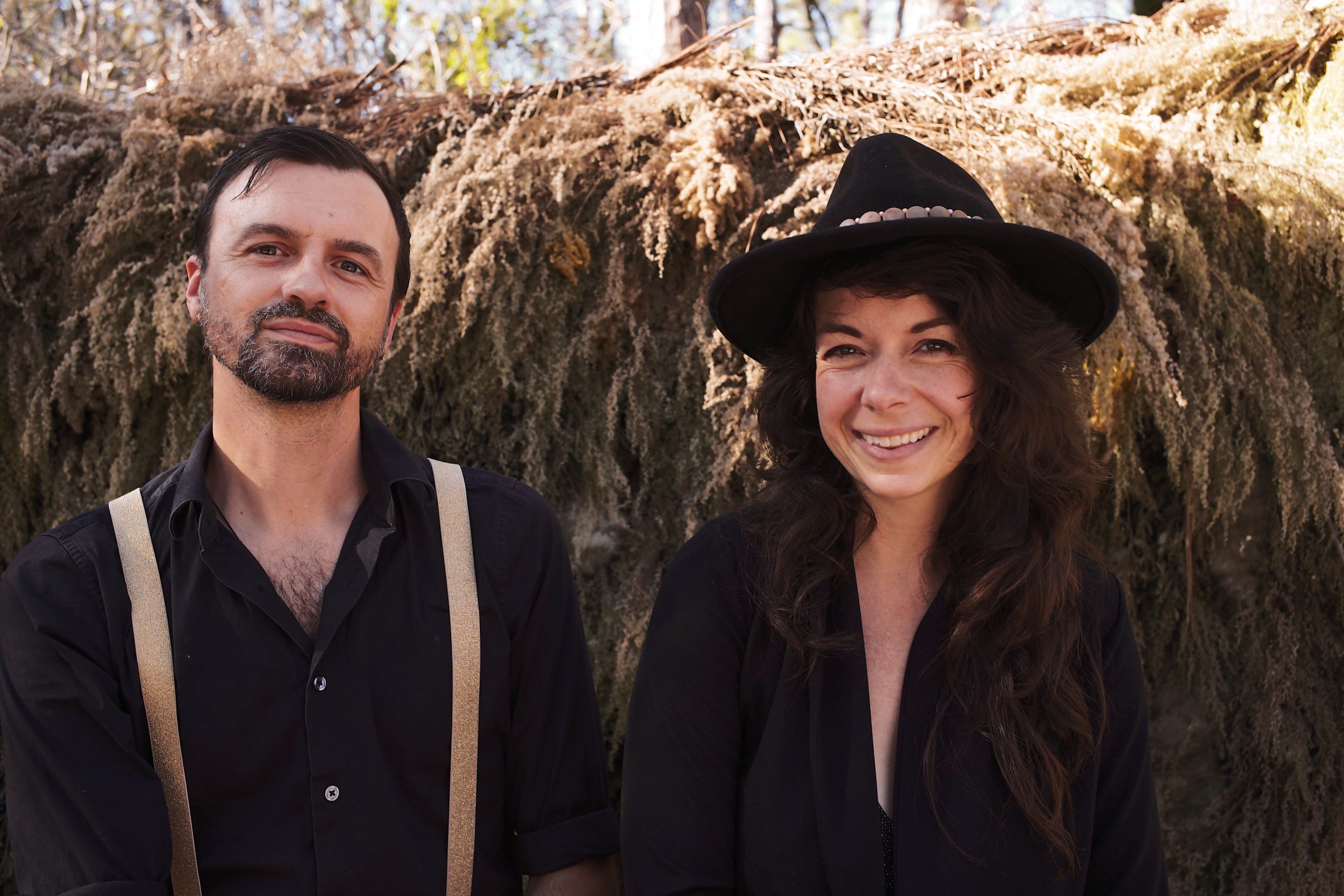
Style Weekly is pleased to share the premiere of a video captured earlier this summer in which Laney Sullivan and Jameson Price of Richmond-based folk duo Høly River perform “Steady” surrounded by Earth Folk, the urban collaborative oasis and co-housing project they founded. The song is an ode to the perseverance required to advocate for peace and environmental sustainability — not just when times are tough, but through a lifetime.
Over harmonium and looped jaw harp and ukulele, Sullivan leads with an admission of uncertainty — “I want to tell you everything is going to be OK / But I don’t know, and I can’t say” — before turning that doubt on its head and embracing the only real certainty, change: “It keeps going / Move through it / Keep going / Be steady.”
Those words carry real weight, given the track record Sullivan and Price have established setting advocacy to song and backing those sounds up with action. Earth Folk was founded a decade ago, evolving from a dilapidated turn-of-the-century house on Richmond’s Southside to a thriving creative ecosystem that hosts festivals, fundraisers, a recurring old-time jam and other community-building events. The duo also founded the Fonticello Food Forest, which grows and distributes free food for Southside families on a weekly basis.
That’s all in addition to more than a decade of touring sustainably, connecting with like-minded change-makers and leading the way when it comes to musical messaging focused on respecting natural resources. “This art is like a legacy that you’re leaving on the planet, and it will survive longer than I will,” Sullivan says.
Perhaps most poignantly, “Steady” contains lyrics adapted from the writings of Jameson Price’s sister, Johanna Calfee, who passed away two years ago after a five-year battle with cancer. “Integrate it all / Collecting seashells not the accolades / Honoring the gift of what this life has made.”
For Price, the words reflect both his sister’s enduring spirit and a broader truth about living with intention. “Even when it seems like your cause that you are advocating for isn’t going to be successful, there’s still a steadiness in your approach,” he explains. “Instead of a defeat lens, you still have the steadiness of continuing to show up.”
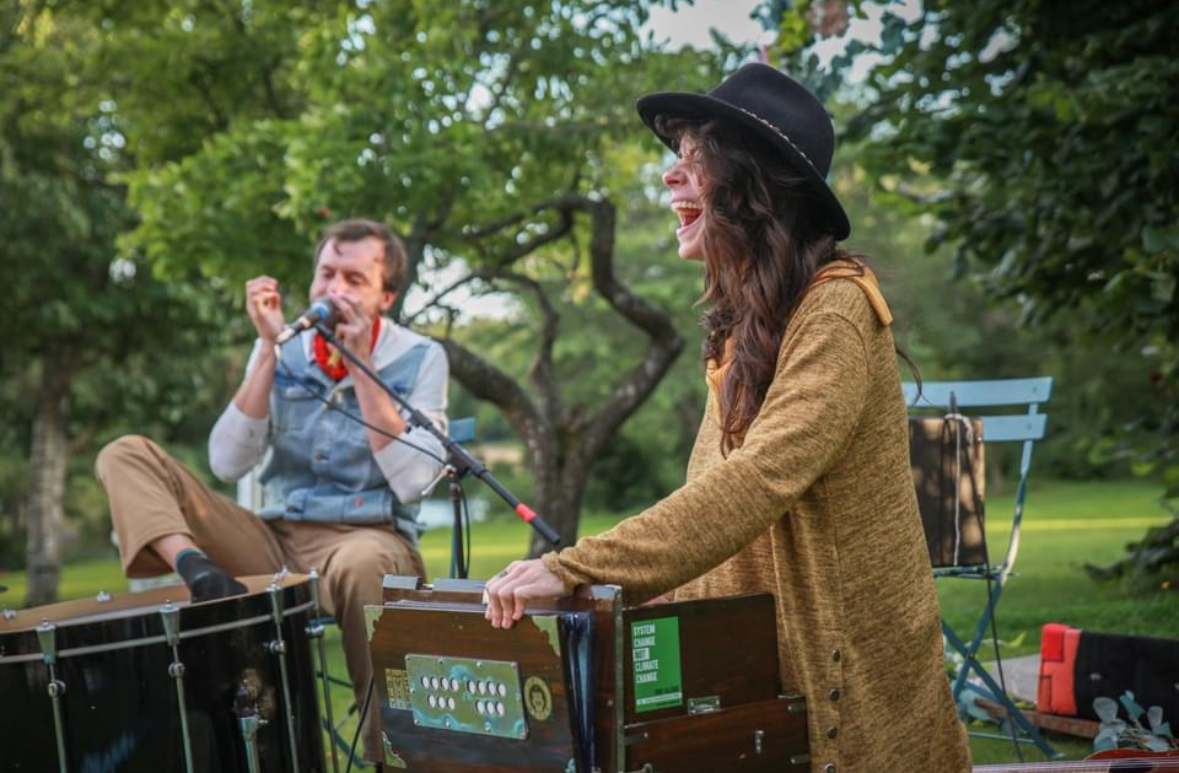
“Steady” precedes a full-length album titled “Day Is Born” that Høly River plans to release in early 2026 via Richmond’s own Shockoe Records. On it, longtime fans can expect to hear more looping of the kind featured in this clip, which was filmed by Chris Damon and Will Weaver. Sharing a performance video was partially motivated by a desire to show how the Boss RC-505 looping station fits into the duo’s setup, and how each loop you hear onstage at a Høly River show is created in real time.
“Even though we’re incorporating loops a lot into this next album, we wanted to maintain our folk energy and make sure that what we’re doing is live and happening in real time,” Price adds.
Style Weekly spoke with the duo about the song’s origins, about leaning into looping and about how listeners can lean into their own desire to advocate for the cases that matter to them.
WORLD PREMIERE VIDEO FOR HOLY RIVER’S “STEADY”:
Style Weekly: “Steady” could only have been written by someone with sustained experience trying to make a difference. What is it like reflecting on Høly River’s track record of environmental advocacy?
Laney Sullivan: We’ve been playing music for over 15 years now as a touring band. At some point early on, we realized we’re singing these songs every single day, and it’s so powerful that people can access them anywhere in the world and listen to them and integrate them into their own lives and use them to live… Every time we write a new album, we know that we’ll be working with those themes of the songs that we’re writing for the next year, year and a half, two years, five years, who knows? “Courage,” our last album, came out five years ago. So when we’re touring and [introducing] the songs and talking about what inspired them, it’s like sharing part of our lives’ story with audiences, so we really sit and spend a lot of visioning time and time in reflection about “What is this next phase of our life creatively going to be about?”
Do you remember the moment when you decided to use your creativity to advocate for the causes that matter to you?
Sullivan: We used to have a group of people that would go down to the James River and meditate on Sundays. It was called Quiet Time. You could smoke weed, you could do whatever you wanted. You just couldn’t talk. During Quiet Time, I had that first revelation of “We need to use this in a more intentional way — this power of writing music and sharing music.” And I wrote the song “Celebrate,” which is a classic. We still play it almost every show. That song is about believing that there can be a time when our wars on Earth end, and that we put our energy into healing our relationship with each other and the Earth, instead of putting our human energy into destroying our relationships with each other and the Earth. Not that we’re necessarily ever going to get there, but the importance of holding that possibility and working towards that world, even if we don’t see it. We’re trying to make that our world in our small realities as much as possible.
What made you want to share a performance video of this song in which your looping process is featured?
Sullivan: Mostly because you can’t see it very well in when we’re performing live, because the loop station is hidden by Jameson’s drum. Also because of the prevalence in live music these days, especially in our genre, of people using backing tracks that are pre-recorded and singing on top of that. We wanted to make sure people knew that was not what we were doing — that everything is being built in the moment.
When did looping enter the group’s lexicon?
Jameson Price: We looped on “Courage” as well. It’s just we didn’t really build songs around it. We used the loop station more as a drone or as an ambient sound in the background. This is the first time that we started building songs around the loop station, rather than the loop station just being a textural component to an already-existing song.
How did you decide on Earth Folk as the backdrop for the video?
Sullivan: Because of the theme of the song being about the long game and a practice of continuing to work steadily on something. Earth Folk has been one of those projects in our life. It just turned 10 years old this year. Earth Folk started as me and Jameson buying a house that had been abandoned for 20 years and was legally condemned and collapsing into the ground, making it livable and making it a community space. We try to keep it somewhat low-profile, but it’s a pretty well-established space at this point, and it’s in a different phase of its existence…
“Day Is Born,” the new album that we’re coming out with, is about midlife. I’ve just turned 40, and Jameson is in his 40s, and we’re understanding what things look like from this perspective [where] you’ve had a significant amount of time on Earth to accomplish things, and you’re still kind of in the middle of everything… We think of projects over a long span, like children: When they’re born, they take a lot of energy, time and commitment. You have to be there constantly. Then the older they get, the more established they get, and the more of their own sense of self they get. It’s really interesting to see that happening with different things we’ve initiated, like the band, like Earth Folk, like the Fonticello Food Forest, which we founded, and which is almost 10 years old, also.
What are are you most proud of looking back on those efforts?
Sullivan: I think it’s when you can start stepping back as the founder and the originator of the idea and watch new people stepping up. Seeing it become more independent. And with the music, [seeing] the way that it spreads… People find it. We tour mostly the Southeast, and [it’s also gratifying to see] how effortless it is to book a tour. Basically, I’m just calling our friends and beloved community members in different cities around the country and setting up house shows and other shows. It gets easier.
That idea of ease — of finding sustainability in one’s approach to effecting change — is reflected in the lyrics to “Steady.” What made you want to communicate that in song?
Sullivan: The first thing that comes to my mind is [that] you can’t keep going otherwise. There are hard times, of course. There are really difficult times, and you have to be resilient. But you don’t want to live your life in constant conflict, and you want to love the work that you’re doing and feel purposeful, and that your soul is put to ease; that you’re giving your life energy to something that gives you purpose.
Price: “Easeful” is not necessarily the word I would use as much as it would be “lifestyle…” You’re making a decision about your lifestyle and how you’re going to continue to show up. It’s purpose driven, and in that way, it becomes easier, because it’s a larger purpose than just individual advocacy for one particular thing. All roads lead to your continuation of that purpose.
What do you want listeners to know about the lyrics in “Steady” that were written by your sister?
Price: My sister wrote a lot about that steadiness. Even though she knew her journey was hard and it was getting more medically complicated, she had steadiness in her motherhood, in her sibling-hood, and in her being a daughter — all of these things that were part of her lifestyle that she just kept showing up to and kept being part of. That steadiness, and the approach to those hats that she wore, in addition to the hat of going through a difficult medical journey — there’s a relation there to picking a lifestyle and picking your direction of your advocacy.
What advice do you have for people who are starting their own journey of advocacy?
Price: The larger you get about the issues, and the larger the issue feels, the harder it is to feel like your voice is heard. It feels like you’re just throwing pebbles at a ginormous wall. And so usually the advice is: Find something local and [find] people that have been doing the work locally and plug into something that you can see, [that] you can more easily see results out of, and usually that leads you to larger spaces. If it’s environmental, we’ll say, “Is there a park that you enjoy going to?” Or “Do you enjoy the water?”
Sullivan: What water do you drink?
Price: Right, we ask that question from the stage: “Do you know where your water comes from?” — bringing people’s awareness to where their water comes from. Then being able to name it and say there’s probably an association or a civic group around this water that you can join, or [if] there a park you like to walk, there’s probably a friends-of group or a civic group around that park.
Sullivan: Personally, some of the most meaningful work that we have built into our lives is the work that we do with the Fonticello Food Forest, particularly. The food pantry, or that we do a weekly food distribution that serves up to 100 people a week. That started because I used to volunteer with Food Not Bombs, and learned how to do it, and then just started my own. So many other people have joined to help keep that going that I’m not even there helping anymore, as much as administrating.
Price: And other groups have popped up as a result as well. You just form the relationships and the connections. You see others — they’re interconnected, because intersectionality is a huge part of any cause, and then you micro-network from there… Starting locally does put you in a space where you actually can get your hands on the work more quickly.
Sullivan: There’s just so many people in Richmond that are doing such amazing, inspirational work. That’s one of the reasons why Jameson and I chose to stay in Richmond and continue to be part of the community — because we’re so inspired by our peers.
Høly River will perform at the Great Big Greenhouse on Saturday, Sept. 20. Deau Eyes will also perform. Music starts at 4 p.m. To hear and purchase Høly River’s music, visit holyrivermusic.com.