Ian Tuason’s “undertone” is the work of a talented filmmaker who wants to get a foot in the business — a calling card movie, in other words. And no doubt it will be successful on those terms. We will be hearing from Tuason again, I assure you.
But that’s all it is: a derivative and impersonal display of a skill set. Young people new to the horror genre may have fun with it, but aficionados should expect weak sauce.
Evy (Nina Kiri) is a young woman caring for her mother (Michèle Duquet), who is bedridden from a terminal illness. Other signifiers pile up: a boyfriend who doesn’t understand Evy’s commitment to her mother, a friend and collaborator who is clearly in love with her, news of a pregnancy and pointed Christian iconography.
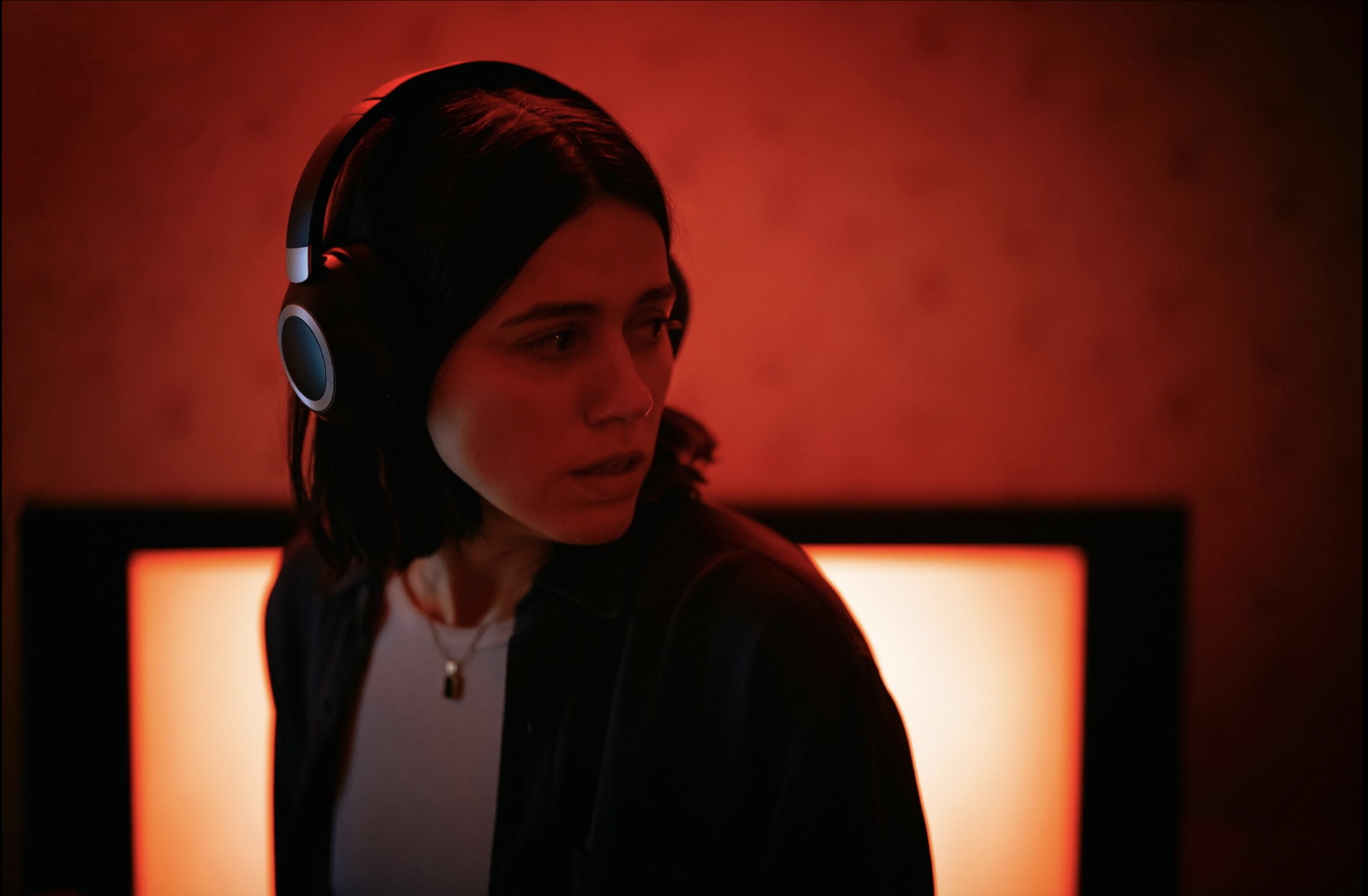
The movie is set entirely in Evy’s mother’s house, which is a festival of open space and nooks that invite the audience to play reliably fruitless games of spot the ghost. Evy and her mother are the only characters onscreen. Everyone else is heard over the phone or on the podcast that Evy hosts with said smitten collaborator, Justin (Adam DiMarco).
The podcast, which shares its title with the movie we’re watching, pivots on Evy and Justin looking into creepy audio footage. Justin is the all-believing Mulder to Evy’s skeptical Scully. This movie kicks off with Justin sending Evy a weird email with 10 audio files that seem to document a couple that’s in the grips of a demonic disturbance. The wife talks in her sleep, weird sounds abound, children’s songs are played backwards, etc.
The bit with the 10 files is clever, as it affords “undertone” an inherent countdown structure. This is the sort of cleverness that shows you that Tuason knows what he’s doing. He’s pretty good at getting you to forget that you’re watching an entire movie about a woman listening to files in a dining room.
And Kiri is a find, a beautiful and thoughtful actress who compels you to believe that Evy believes. She is not a snarky horror-movie actor who invites you to hold yourself above the proceedings. Given how much of “undertone” consists of close-ups of Kiri’s face as she listens to haunted audio files, her efforts are integral to this movie being watchable.
But her performance isn’t enough.
With its surprisingly lush and gothic cinematography, “undertone” is a traditional horror movie, but it is structured like a found-footage movie, and this combination cancels itself out. Found footage movies compensate for very little plot and less production value with a promised illusion of reality, while traditional movies go in the opposite direction, bringing flamboyant shock effects and lurid twists.
Meanwhile, “undertow” merges the boringness of found footage with the contrivances of regular horror, begging for either a bolder or subtler approach.
There are no visceral shocks and no narrative surprises, and the audio files are nothing that you haven’t encountered in other horror movies or TV investigations into the paranormal. This footage doesn’t invite you to pore over each hiccup for a suggestion of the uncanny. You hear what you’re meant to hear in order to push the scant plot forward.
I thought of Francis Ford Coppola’s 1974 thriller “The Conversation,” in which Gene Hackman replays footage of a couple talking, isolating each visual and aural element until the footage seemed to say everything and nothing. Coppola and Hackman and editor Walter Murch took you so deep into that footage that you felt you were on the edge of an existential abyss, and there was a nifty twist too, hidden in plain sight.
Tuason’s audio footage doesn’t have any hidden dimensions. You assume you’re getting a demon and you get a demon. Or at least vague intimations of one.
It’s not fair to use a masterpiece against a debut, so let’s get humbler.
“Undertone” most explicitly brings to mind Scott Derrickson’s “Sinister,” which followed Ethan Hawke as he swelled bourbon and watched 16-mm home movies for hints of demons. That movie was derivative as well, but those home movies were creepy and so was the villain in his irrational, dreamlike ludicrousness. The movie went a little harder than one would expect from a product out of the Blumhouse mill.
The villain who eventually arises from the murky audio depths of Evy’s research is clearly modeled on the thing from “Sinister.” Once you make that connection, “undertone” comes to feel like a rehash, especially the climax that quotes Derrickson’s movie verbatim.
If you longed to have “Sinister” remade as a filmed podcast, “undertone” has you covered.
Gianfranco Rosi’s “Pompei: Below the Clouds” is the most ravishingly beautiful documentary that I’ve seen since the 2023 “Menus-Plaisirs — Les Troisgros.” The latter is the final film of the renowned Frederick Wiseman, who died last month at the age of 96, after decades spent vitalizing the documentary form. I do not evoke the mighty Wiseman lightly, but Rosi earns the comparison.
“Below the Clouds” is a mixture of travelogue, poetry, and survey of the infrastructure that enables a society to operate. Whether he was making a movie about a Michelin-starred restaurant or a museum or a strip club or a neighborhood or a high school or a hospital, Wiseman was obsessed by how societies work on a tangible level, away from the reductions of political platitudes. Rosi has similar concerns.
“Below the Clouds” is set in and around Naples, in the shadow of Pompei and Mount Vesuvius. It is shot in rich black and white, which brings to mind Italian neorealism or, moving in the opposite direction, the surrealism of filmmakers like Federico Fellini. The ancient architecture and primordial landscapes merge with the contemporary street scenes to suggest an operatic explosion of everything. In “Below the Clouds,” the tangible and figurative cohabitate freely.
Like Wiseman, Rosi eschews the tricks of the modern infotainment documentary industry. There is no narration here, or onscreen text or talking-head interviews. You will probably on more than one occasion be unclear as to where you are or who you are watching. A specialist of some kind surveys an enormous pile of Greek and Roman sculptures that suggest how casually past eras collapse together into the present.
Rosi and Wiseman distinguish between experience and information that you will soon most likely forget anyway. When wandering a museum, is your time really well-spent reading those cards in front of the art? Rosi and Wiseman’s styles intensify the audience’s engagement. They expect you to come to them and make your own conclusions.
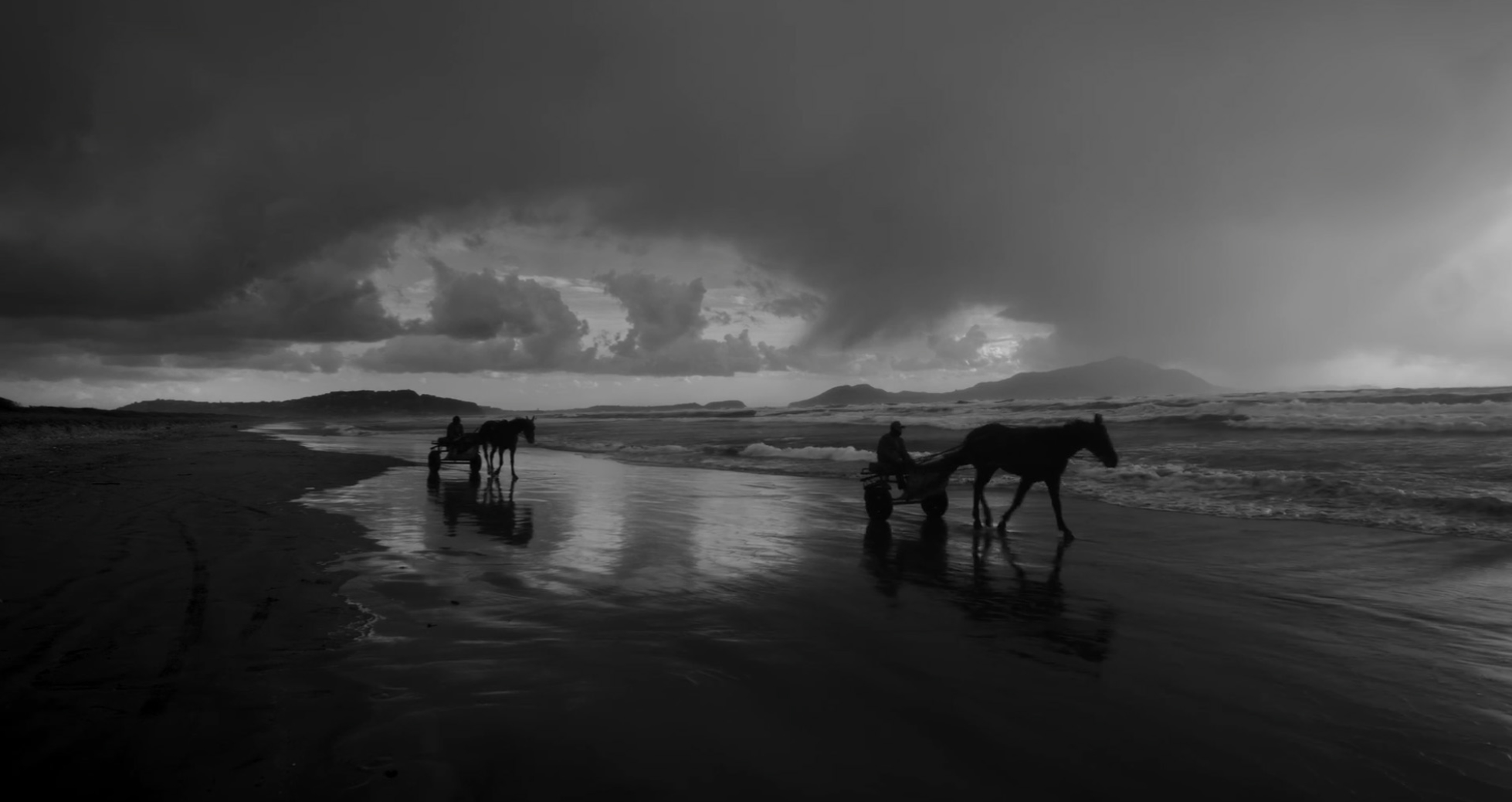
Several strands coalesce in “Below the Clouds.” Firefighters investigate the invasion of ancient tunnels running under the city, which is a concern of the government. We learn of how thieves can crawl into terrifyingly small tunnels to lift priceless frescoes that survived thousands of years of natural chaos but can’t quite elude human avarice. Syrian shipworkers delivering grain to Naples contemplate the danger of having to return to Ukraine amidst Russia’s bombing. Many ships have suffered casualties this way.
We see emergency operators handling frequent phone calls asking about tremors that they fear could be Vesuvius, a thread that Rosi fashions into a leitmotif and perhaps the film’s governing metaphor. Beauty and the threat of collapse interlace. An embodiment of the human condition? I don’t want to get too carried away but this is the kind of movie that gets your mind percolating.
Rosi’s tone is hushed, empathetic, and his attention is rapt. We’re allowed to watch and to savor and enter into a meditative state. There are images here of mysterious sublimity, like that of a Japanese scientist who brushes away debris to reveal the skull of a dog that’s been in the ground for eras. Even a dog that has been dead for an eternity is capable of being noticed, and a movie of such democratic curiosity is inherently optimistic.
Doom may approach us, and distractions are legion, but there are people who refuse to lose sight of the value of life, from vast cityscapes to human longing to a dog’s incisors.
The movie “undertone” is in theaters everywhere. “Pompei: Below the Clouds” is playing at Movieland and will be streaming on Mubi later in the year.