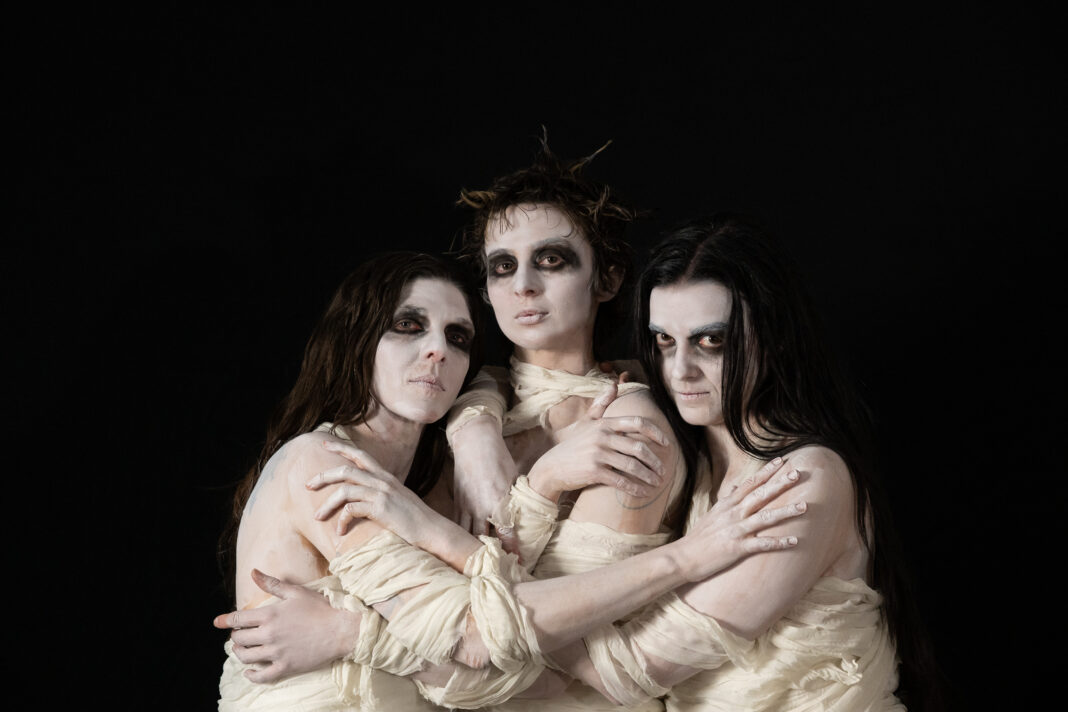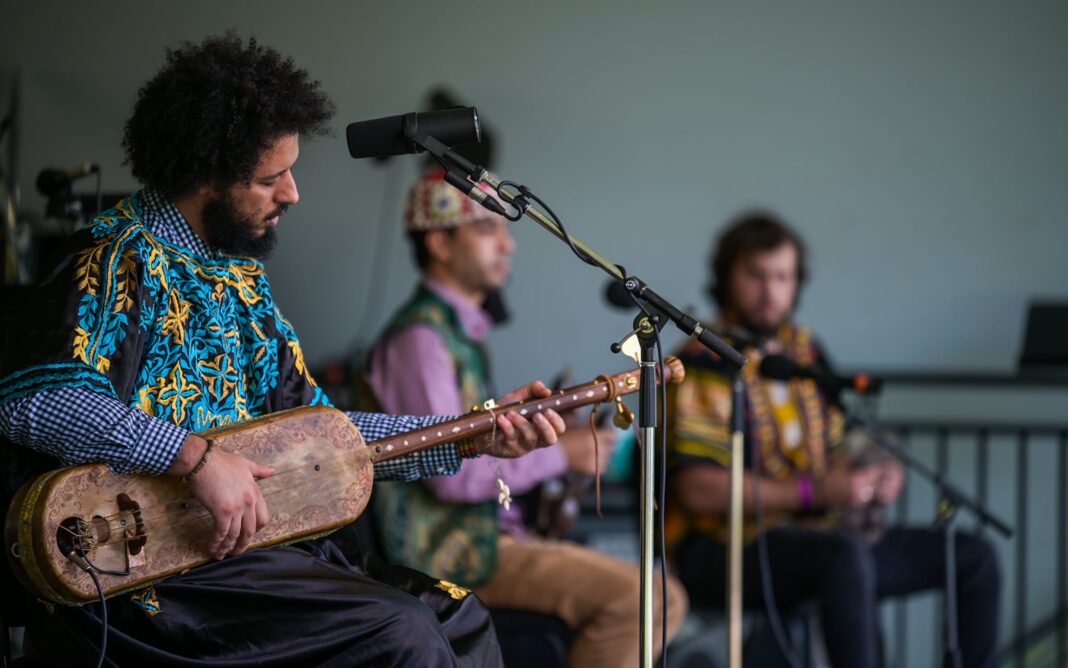
It may seem like the ever-changing, Richmond-based rock band Opin has been quiet of late. In actuality, the trio of multi-instrumentalists is only getting louder.
Vocalist Tori Hovater has seen how a flurry of activity can drift under the radar. “I run into people all the time lately that are like, ‘Are you still playing music? You still in that band?’” she says. “And I’m like, ‘Oh yeah, of course. Why would you even ask?’ Because in my mind, we’re so active … I forget that we’re doing a whole lot of this within the confines of the practice space, so how would anybody else know?”
Opin is currently wrapping up work on a new album, “Valley Boombastic,” which will be its first song-based LP since 2020’s “Media and Memory” (WarHen Records). In the time between, the band — rounded out by vocalist Landis Wine and former Navi guitarist Jon Hawkins — set up a new practice and recording space on Hospital Street. The location doubles as the title of a series of improvisatory electronic pieces they captured, culled and split between two 2021 mixtapes that previewed the exploratory workflows their new environs afforded.
“It’s a shift for us, for sure, but it feels natural at this point,” Wine says. “It’s the closest thing that we’ve gotten, in my mind, to an expression of how we work together, and how that feels when it’s locked in.”
The next step? Boiling those extended pieces down to song-shaped structures for “Valley Boombastic,” which is projected to cross the finish line after a session next month in Philadelphia with experienced producer and sound engineer Jeff Zeigler (Kurt Vile, The War on Drugs). In the meantime, we have “Exit Check,” which provides a glimpse into Opin’s next phase, as well as a reminder that “we do still occasionally play four-minute, or three-minute pop songs,” as Wine puts it.
Longtime fans know well — from Opin’s run of innovation dating back to 2017, and from the output of indie rock group White Laces, in which Wine and Hovater first collaborated — pop structures can go in countless directions. “Exit Check” burrows into darker, more cloistered and crunchy sonic territory, recalling formative basement shows that foregrounded the pure joy of plugging in and turning up.
“If it feels good to play it — if it scratches that itch — just go for it,” Hovater says. “That definitely ties back to the feeling of being at a house show or a DIY space, where the environment is just different.”
Style Weekly: How did the new practice and recording space take shape?
Landis Wine: We had actually set up a little bit of a space, like a practice space and an ad hoc studio spot, up in Tori’s house. It was on the top floor … We had a show up there once, which was not advisable, but it was fun. Then Tori moved and decided that she, understandably, wanted a little bit of her personal space to live in at her new spot. We happened upon a pretty cool spot down on Hospital Street. It used to be a DIY venue … We had done the last record partially at Spacebomb [Studios] and took some of it home, and I think from that point on, we were like, “There’s so much of this stuff that we can do ourselves, because we’re playing synths. We’re playing stuff that we can plug into a board, so we don’t need to go somewhere to do it. We just need to make that process work.”
When were you able to start playing together again after the onset of the pandemic?
LW: I think it was April. We started going down [there], and we were like, “Obviously we’re not going to be getting ready for shows, so let’s set this up to record.” From there we started improvising for an hour or two almost every week… After a bunch of months, we started to cobble together things that felt like songs. Other things definitely didn’t feel like songs, and a lot of that ended up on the mixtape we did, “Hospital Street” …. It was a nice escape to occupy another space that is not complete, full-on dread all the time.
Tori Hovater: The whole “Hospital Street” thing was — I don’t want to call it an accident, but all of those are moments in time that were only played once, [and] that was happening at the same time that we were developing these ideas that would become what we’re actually releasing now… It was definitely a crucial turning point in the writing process, because we were not having to prepare for anything. We could just stretch out and play for the sake of playing. It was really for the pure joy of it.
How has that approach made its way into your live sets?
LW: Once [COVID restrictions] sort of calmed down, we did a handful of shows, and we brought really early versions of what the new stuff ended up becoming. At MACROCK [in Harrisonburg], I think we played three songs and the last one was a 14 minute version of a song that’s now a tight four minutes … We were just trying stuff in front of people, which I’ve never done in a band. I was always of the background like, “You’ve got to practice. You’ve got to be right and ready to go.” I’m a big fan of improv music and jazz and that sort of thing but was always very nervous about doing that and ended up diving headfirst.
TH: From my perspective it’s a little bit different from [Landis’] and Jon’s, because I’ve played so many setups. So [has Landis], because [he] started playing the [Fender] Bass VI. Jon has swapped his gear out a little bit. But I feel like I’m in this constant, slow-rolling state of “OK, I’m playing this synth, or pair of synths, for a while, and I’m going to figure out how they work, and then eventually I’m sure another one will fall into my lap and I’ll figure out how that works.” It’s a process that starts itself over and over again. The [Korg] minilogue, though, I’ve played for a really long time. That definitely is an instrument that I feel like I finally have some mastery of.
What other new tools have you employed lately?
LW: Tori came with me — I met a guy in a semi-shady deal out in front of Hollywood Cemetery to pick up a very deeply discounted [Roland] JUNO-60, and Tori has been using that for, I feel like, everything we’ve done for this whole thing … Tori’s got a really great, intuitive sense with drone and textural stuff. For a lot of things, even on the “Hospital Street” stuff, it’s one note for about eight minutes, but if you take that element out of it, there’s nothing. It’s the glue that somehow manages to make it feel like it flows. So I think, compositionally, that was a change on [Tori’s] side.
TH: There was no deadline that we had to meet, so it was definitely an opportunity for me to have a departure from “OK, let me listen to this and figure out what riff goes there.” Instead, it can just be one note. It can be on a synth I’ve never played before — just being able to enjoy things as they unfold. I feel like I’m almost sometimes in the passenger seat when these things are happening [laughs].
“Exit Check” is a great example of using texture and space in a new way. What inspired that turn?
LW: Being back in a smaller space, even if it is a studio setup, pushed us to [make music] that was a little more energetic and a little bit heavier. For me, it harkened back to when I was in college and I would venture out very tentatively. I wasn’t stridently going to shows, but I would wallflower it and go to shows at 9 North Blvd. and the Bone Zone and every other possible DIY spot that came and went… It’s not fully evident through “Exit Check,” but it’s a mix of really sludgy stuff and then stuff that almost feels like house music at times, and both of those are things that I’ve experienced in these tight, cramped, sweaty environments.
TH: It really serves a function as far as scratching an itch. [With] “Media and Memory,” I had such a good time working on it, and I’m still really proud of that record, and I’m happy with how it came out, but it was such a different working environment … “Exit Check” is a little bit grittier than I think what we would usually do, because it was more about getting into a space and playing for the sake of playing, and if something sounds good just keep it going.
What’s been most rewarding about this new chapter for Opin?
TH: I think the new songs are fun because they’re dialed in in a different way … With the new stuff that we have, yes there is structure, yes we have recorded versions of how it sounds in this iteration, but I think we have a lot more freedom playing live to be able to go off the rails a little bit. Maybe this song suddenly today has a four minute intro that we just went for, and it’s kind of fun to be able to change it up a little bit…
On that note, something that’s been really critical for me is my relationship with [Landis] and Jon. [Landis] and I have been playing music together for like seven years now, and like five years with Jon … I know that I’m never going to get a response [like] “What are you doing? Why did you think that would sound good?” That gives me a lot of peace of mind when it’s kind of going off the rails. I know we will all be able to support each other in whatever weird sh-t we decide to do next.
To hear “Exit Check,” visit opinband.bandcamp.com. Opin will perform at the opening reception for the Rapid Eyes “Not Fine Art” show at Black Iris on Sept. 1. For the latest on Opin’s releases and performances, visit linktr.ee/opin.