On Sunday, Feb. 15, news broke via the Timothy Bailey & the Humans Instagram account that the band’s leader, real name Timothy McCready, had died. He was 53 years old. Bailey’s longtime friend and collaborator, Bob Massey, revealed in a subsequent Substack post that the cause of death was suicide.
To Massey, the news of his death was “a brutal shock, though not entirely a surprise.” Bailey has alleged in the past that he endured the long-term impacts of psychological issues stemming from his childhood, which the singer-songwriter, bandleader and virtuosic composer has addressed lyrically, in interviews about his music, and in his own writings and workshops.
“He was very open and transparent about his own struggles,” says Humans drummer Greg Weatherford [a former editor at Style Weekly]. “He made sure that people knew, not because he wanted their pity, but because he wanted them to understand [that] actual possibility for grace and beauty is always there.”
According to Weatherford, Bailey had been diagnosed with dissociative identity disorder (DID). Studies have shown as many as seven in 10 with DID have attempted suicide. Bailey has previously told Style that he experienced multiple psychiatric hospitalizations, yet during two windows of productivity — one in the 1990s and another that spanned his last decade — the stars aligned for him to make singular and indelible contributions to Richmond’s music scene, from nearly breaking through with the rock band Schwa to recent recordings made alongside the Humans and some of the city’s most respected session musicians.
Since his death, online tributes from past bandmates and collaborators have steadily surfaced. Bob Massey called Tim “a luminous being” and described Humans shows as “occasions of cultic fervor. People struggled to describe the transcendent bond they felt with him.”
Bailey’s former Schwa bandmate, Michael Hearst [a composer, multi-instrumentalist, writer, and producer based in New York] said in an Instagram post:“I learned so much from this human — from appreciating the asinine and turning it into art, to playing a second-inversion chord on the guitar. But most importantly, he taught me how to collaborate.”
Doug Nunnally, founder of the Auricular and president of the Newlin Music Prize, noted in an email newsletter that “Tim had this ability to always leave me seeing things differently, in his music and in short conversations. It wasn’t just his words, but the care and clarity with which he spoke (or sang) about hardship, grief and recovery.”
As Weatherford sees it, Bailey’s living past 50 is a victory rooted in courage.
“[Tim] devoted the last decade or so of his life to being human, openhearted and giving, and he used that, I think, as a way to live much longer than anybody would have thought he would.”
A dedication to craft
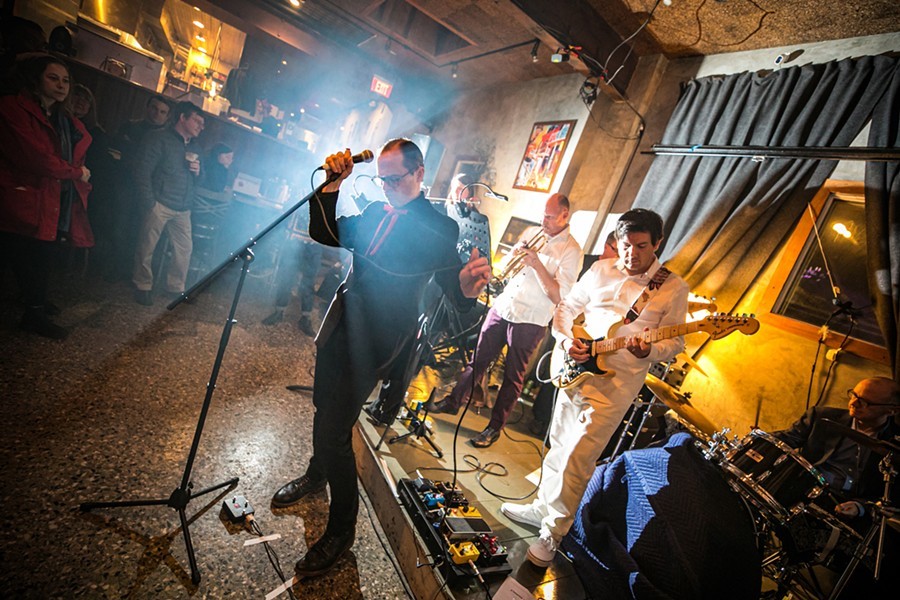
Bailey and Weatherford got to know one another around a decade ago as regulars at Lee’s Famous Recipe Chicken, during a time when Bailey was working part-time at Pleasant’s Hardware, whose former Broad Street location was a stone’s throw from Lee’s. The fried chicken spot became something of a band headquarters as the Humans developed into a quintet featuring Bailey as lead vocalist, Weatherford on drums, Ben Nicastro on guitar, Doyle Hull on bass and Melissa Sunderland Jones on violin and viola.
Both in the context of the band and outside it, Weatherford remembers Bailey as a meticulous craftsman. Bailey was a masterful woodworker, for one thing. “He decided he needed a little cabinet to carry around his equipment, and so he just built it, and it looked like something that had been machined at a factory,” Weatherford notes. “That stuff is really detail-oriented and about fitting parts together and making sure everything fits perfectly, and so that carried over into everything,” he says.
Weatherford cites Bailey’s clothing as another example. “He’s a guy who didn’t have a lot of money, but he was very particular about what clothes he wore,” he says. “He would buy jackets at a thrift store, but then he’d have them tailored so they’d fit just right.”
When leading Humans gigs, Bailey regularly wore a suit. Billy Bacci, the Richmond-based singer-songwriter and multi-instrumental member of Hotpants, credits Bailey with teaching him how to dress for the stage. “I had the pleasure of playing guitar with the Humans at Quarry House Tavern in Silver Spring,” Bacci says. “I used to just show up wearing whatever. He made the point that a performer should be dressed better, or at least more interestingly, than the audience. They paid good money to see you, and it’s your duty to give them your best.”
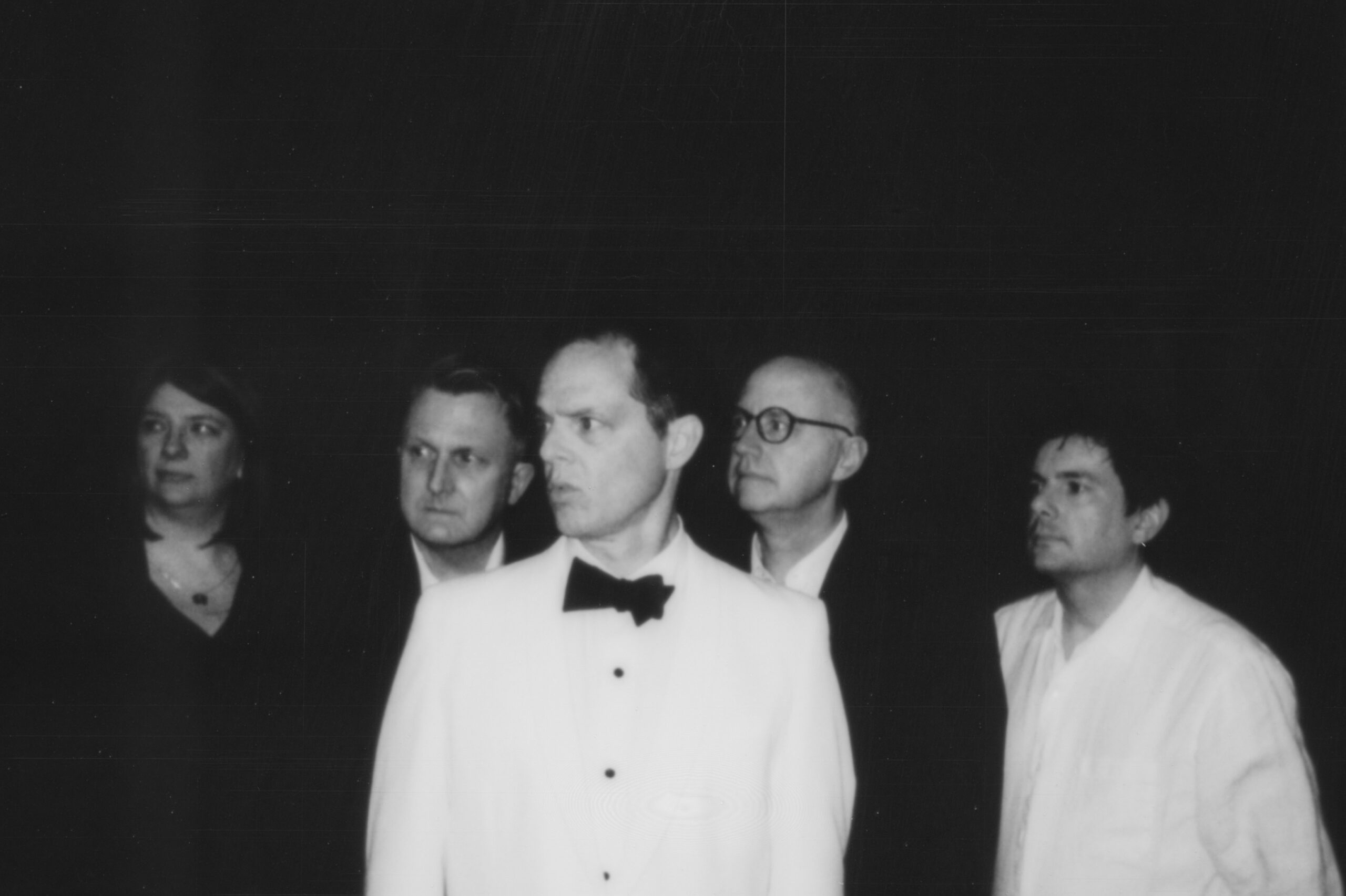
Bailey applied attention to detail to an exceptional degree in the studio setting. The self-titled debut Timothy Bailey & the Humans album was recorded at Spacebomb Studios in Richmond with the help of two high-profile co-producers: Chad Clark of the critically acclaimed group Beauty Pill and Bob Massey, a Creative Capital grantee who met Bailey while the two were active in 1990s local music scene. The sessions at Spacebomb were a moment of alignment when Bailey’s artistic drive, mental health and support network clicked into place to allow a complex vision to come to life.
“It’s a pretty fascinating thing for an artist to arrive on the scene fully formed,” Bob Massey said in an interview with Style Weekly at the time. “Tim has had all these years to really think through what his aesthetic values are.”
“Tim had always written out the parts for the strings and the guitar parts and things like that,” Weatherford explains. “He would usually leave the rhythm section stuff to us, pretty much, [but] everything else was very, very carefully crafted. What I didn’t know until we got into [making] the record and people started showing up hauling glockenspiels and French horns and violas and cellos and on and on was that he had this entire symphonic orchestration in his head that he had arranged.”
The album was tracked over the course of two weeks. Basic tracking was finished within two days, thanks to the band’s exhaustive preparation; the rest of the fortnight was spent capturing additional instrumentation via overdubs. “It was astonishing and hilarious to me every time somebody else would show up,” Weatherford adds.
He also saw the toll that making the album took on Bailey — as well as his satisfaction at the results. “At the end of it, we were totally exhausted, especially Tim,” Weatherford notes. “He’d basically been living there the whole time, and I said, ‘Tim, I think you just recorded ‘Sgt. Pepper’s’ on a budget in two weeks.’ And he said, ‘I feel like I did, yes.’ It was just extraordinary.”
Chad Clark says that Bailey was interested in making a statement: “He wanted to be heard. He had ideas. He had feelings he wanted to express. He was very serious about what he was doing.”
Making space for the message
Bailey’s writing exhibited unflinching candor, both within and outside the musical context. Around the time the self-titled Timothy Bailey & the Humans album came out, Style Weekly spoke with author and teacher Valley Haggard, who worked with Bailey as part of her Life in 10 Minutes workshops. Those workshops were a key step in Bailey’s journey toward openness about his past trauma.
“He’s allowed himself to unravel these stories [where] there’s immense pain,” Haggard said at the time. “There’s immense suffering, but the reason we’ll go anywhere with Tim is because the language is so beautiful. There’s so much humor, there’s so much tenderness, and there’s so much humanity.”
Weatherford says it was gratifying being among the instrumentalists who helped Bailey’s words take flight as songs. “There were no egos in that band,” he says. “The band was entirely focused on making the record and the live performances as good as they could be, because we wanted the songs and Tim’s performance to be free and not hold it back or grandstand in a way that would take away from the music.”
“We knew that a lot of the things he was talking about are really painful or scary or dark, but also beautiful,” Weatherford adds. “The songs and the lyrics were never intended to be frightening or mean. They were meant to be human, and we all really connected with that, because being human and being vulnerable and being honest is the heart of what that band did.”
While working with Bailey and the Humans in the studio, Clark noticed how devoted the band was to Bailey’s art: “Tim was the visionary, and everyone in the band was dedicated to that vision and to making sure that his ideas came through.”
“All bands have internal cultures,” Clark adds. “The internal culture of Bailey and the Humans was just as lovely as the music, which is not to say that there wasn’t any struggle. Anytime you have someone who is as strong-willed as Tim is, I’m sure there will be conflicts [but] my feeling about the band was just these very sweet people who were very dedicated to making sure Tim’s vision came through. And they cared a lot about details.”
Erin Lunsford, a fellow Newlin Prize shortlist nominee, has been on her own journey of singing, songwriting and setting a visionary course for an exacting group of musicians, given her leadership of the powerhouse indie-pop outfit, Erin & the Wildfire. Bailey called on Lunsford’s experience as a session vocalist when making the 2022 Humans album, and he enlisted her expertise as a teacher of voice when looking to refine his rich, distinctive baritone singing.
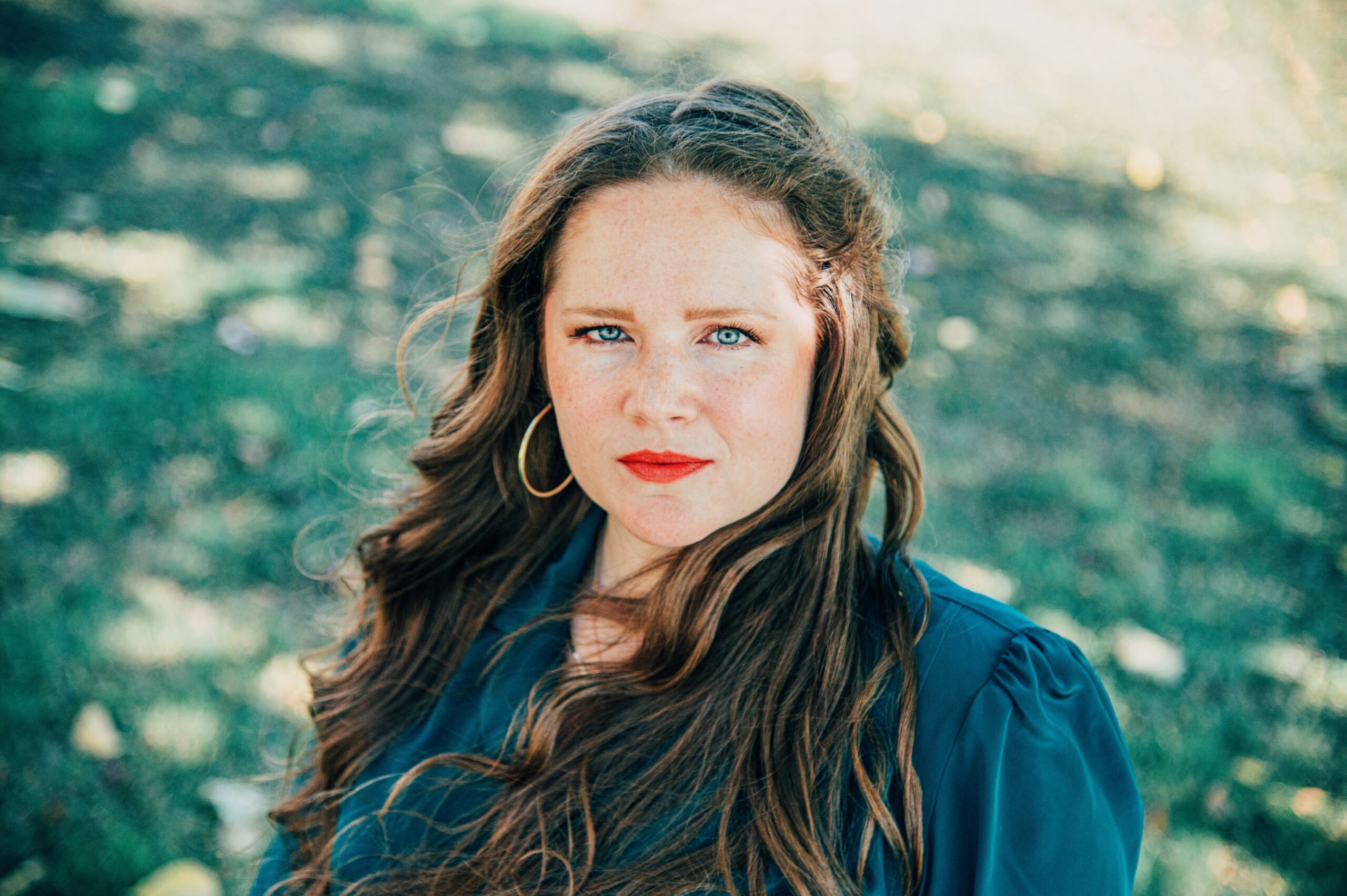
“He had a clear vision for his work in both places,” Lunsford says. “In the studio, he had elaborate, careful, almost operatic vocal parts in mind that he asked me to record with incredible patience and enthusiasm on his part. In our voice coaching sessions, he came to me with specific goals to better master his voice, from onset technique to pitch recognition to vibrato speed. But his first goal was to sing better with others through harmony and blending tone. I will always remember Tim as a creative with distinct vision, so much heart, and passionate desire to connect deeply to the world through his art.”
A prodigious start
Bailey’s journey as an artist began in Virginia Beach, where he grew up and attended Cox High School. It was around that time he began studying jazz guitar. “Tim just excelled immediately and, without a doubt, was a prodigy guitar player, musician, everything,” says Michael Hearst. “Even in our yearbook, there’s a picture of Tim as most likely to succeed.”
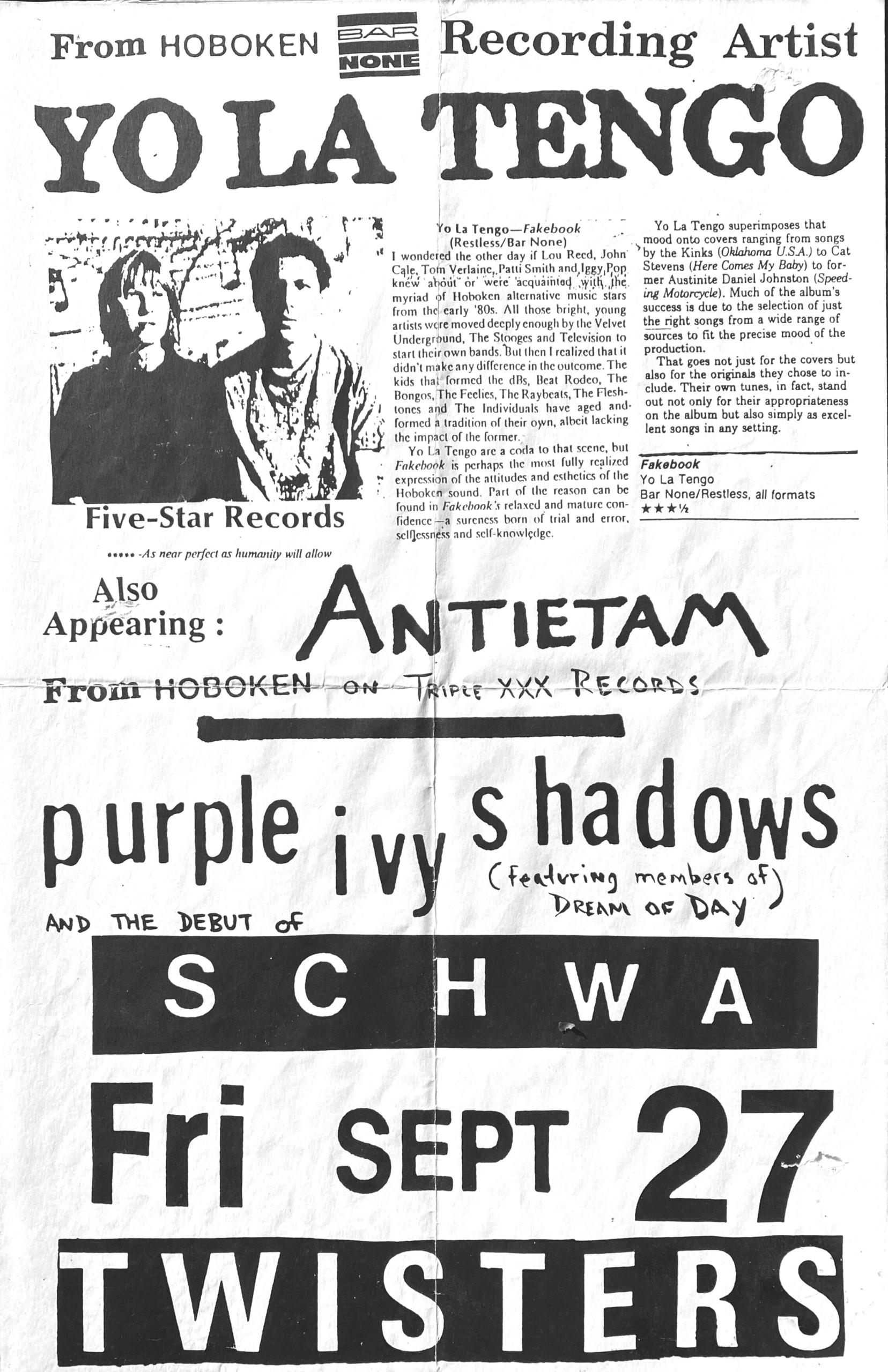
Bailey went on to attend William Paterson University in New Jersey, studying under jazz guitarist Bucky Pizzarelli, though his tenure was short owing to struggles with his mental health, and he wound up returning to Virginia Beach. It was there that he founded Schwa with the help of Hearst, his former middle and high school classmate who was home for the summer after his own first year studying music at VCU. The nascent band practiced at parents’ houses and played shows around Norfolk and Virginia Beach. In 1992, Bailey moved to Richmond to continue pursuing Schwa alongside Hearst.
While Bailey also continued his music studies at VCU, Schwa provided an alternative outlet for his talents. “At that point,” Hearst remembers, “He was like, ‘I want to unlearn everything I’ve learned in music school and just rock.’”
Rock they did — at gigs at local venues such as Twisters, at indie rock festivals and on the college circuit along the East Coast. Bailey had already begun applying his multifaceted craftsmanship for the benefit of his band; at the same time, while honing his skills working at the Harrison Higgins furniture shop, he outfitted Schwa’s Ford Aerostar minivan with a loft for storing equipment and what Hearst describes as a “totally absurd but awesome” Victorian-style sofa with upholstery that functioned as a backseat.
Schwa made it all the way to the cover of CMJ, the era’s preeminent taste-making magazine, resulting in a flood of attention from record labels. Hopes and ambitions ran high in the band, but a deal never materialized, and the relationship between Hearst and Bailey became strained. But Hearst still sees it as a foundational friendship and hoped they’d eventually pick up where they left off.
“He really was my first grown-up best friend,” Hearst says. “Here we were trying to figure out the world without parents and he had his bouts of depression, and so did I. We both had mental health issues. I was in and out of psychiatry all the time, too. So we had that in common and both were taking different SSRIs back in the ’90s, when it wasn’t cool to talk about that stuff. But we were able to share it.”
Making music again
Bailey’s time with Schwa and Fashion Central was followed by a long period of creative dormancy. It would be two decades before Bailey would return to meaningful music making; in the years between, he moved between Richmond and Washington, D.C. and worked jobs that proved unfulfilling. Bailey wrote a well-received opinion piece for Style Weekly in 2023 describing himself as a “Rip Van Winkle of the music world” and noting the stark differences between the music industry he nearly broke into in his 20s and the one he encountered 25 years hence.
“When I finally woke up, it was into a very different world,” he wrote. “It seemed as if there were perhaps no such thing as the music industry anymore, at least not any form I recognized.”
As displaced as Bailey felt, the music he made upon his return was uniquely effective at responding to the state of the world. Chad Clark sees Bailey as an “artist of this moment,” thanks in part to the song “Great Man Singing.” The first track from Bailey’s 2022 album uses an imagined visit to an island owned by Marlon Brando to excoriate men whose charisma masks toxic behavior.
“I think he uses Marlon Brando as kind of an example of what could be Kevin Spacey. It could be Bill Cosby. It could be any number of the people in the Epstein files. And Tim had warred with abuse in his childhood, so I think that is in that song as well… He’s trying to gesture at a huge, dark part of human behavior. That’s a really noble aim, for an artist to say, ‘Look, there’s injustice happening.’ My respect could not be greater.”
Co-starring in the video for “Great Man Singing” was Liza Kate, who also duetted with Bailey on the song “Bottomless Deep,” a standout track from the 2024 Humans album, “New Love Stories.” “I’d never felt like such an important part of someone else’s creative process before Tim,” she remembers. “He knew what I could give better than I did… That I had some small part in his legacy is an unreal gift and I’ll treasure it always.”
Bailey was also fervent in his advocacy — both in his Style piece and on his Substack titled Greater Humanity — for greater awareness of the impact of the streaming music model on artists, calling for a more direct relationship between creators and consumers. Though it’s now on Bandcamp, Bailey’s final album, “Picnic in a Landfill,” was initially available only upon request; to access the album, which was largely a DIY solo effort, listeners clicked through one of Bailey’s Substack posts and received a follow-up email with a free download link.
“It’s the only genuine ‘opt-in’ method I’ve come up with so far to offer my music to people,” he wrote. “Meaningful connection with art begins with choosing which art we encounter. The algorithms are slowly eroding our ability to make those choices. Actively choosing what we want to give our attention to is an act of resistance.”
Speaking to the world
“I think all artists want to feel relevant and want to feel like they’re in some dialogue with the public consciousness,” Clark adds. “I think Tim longed for that beyond his reach as a small indie musician in Richmond. I think that he really wanted to speak to the world.”
Doug Nunnally saw that same conviction of purpose. “To know Tim was not just to love him, but to hold a deep admiration for who he was,” Nunnally says. The self-titled Timothy Bailey & the Humans album made the short list for the Newlin Music Prize, which uses a selected jury of local music professionals (and a public vote) to recognize each calendar year’s best album from the Richmond-Petersburg region. “Great artists change how you see the world, and I believe the same applies to people who carry themselves with true intention. I’m grateful Tim was both.”
Clark’s hope is that the accolades Bailey received during his lifetime are just the beginning. “I hope generations continue to discover Tim,” he says. “I also want to stress to people: Look for the kooky eccentrics in your town. I’m not saying this to Richmond. I’m saying this to everybody. Find the people in your town who make your town what it is. Find the people whose character shapes the town, and celebrate those people and recognize them. Recognize them when they are alive.”
Plans are set for a service honoring Tim’s life in April at the Richmond Friends Meeting House. There may also be future opportunities for gathering around Bailey’s music. Weatherford reports that a musical memorial with performances is tentatively scheduled for July, and that more of Bailey’s music — some from the studio, some from live shows — may eventually see the light of day, adding to the legacy Bailey leaves behind.
“I genuinely believe that there is a celebration to be had,” Weatherford says, “because against enormous odds, Tim made some beautiful things and built a community that was really meaningful to him and other people.”
A service honoring Timothy Bailey’s life will take place at the the Richmond Friends Meeting House on Kensington Avenue on Saturday, April 11 from 1:30 to 4:30 p.m. For more information, visit mykeeper.com/TimothyMccready. To hear and purchase Timothy Bailey’s music, visit timothybaileyandthehumans.bandcamp.com.
The 988 Suicide and Crisis Lifeline is a hotline for individuals in crisis or for those looking to help someone else. To speak with a trained listener, call 988. Visit 988lifeline.org for crisis chat services or for more information.