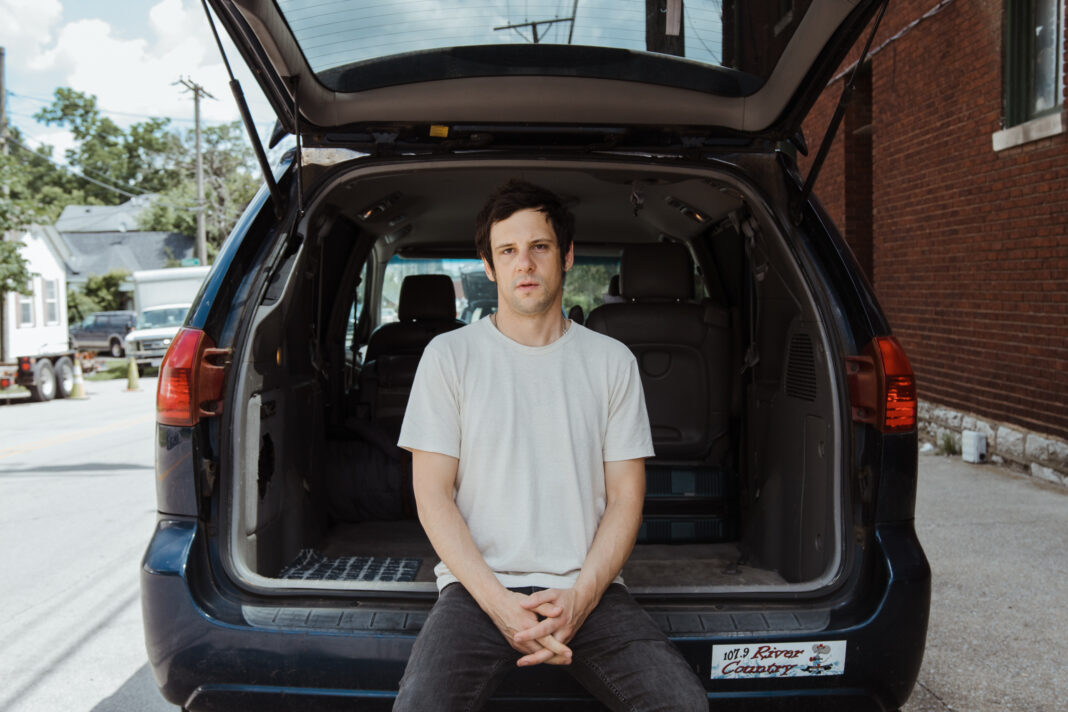
On the morning of Oct. 14, DJ Harrison picked up an urgent phone call. Drummer and producer Questlove was on the line to deliver some devastating news. The beloved soul musician and Richmond native D’Angelo had succumbed to a battle with pancreatic cancer at age 51, and Quest wanted to break it to Harrison personally.
They’ve been acquainted for about a decade, and though Quest, D’Angelo’s close friend and collaborator, knew plenty of people with personal or professional relationships to the reclusive artist, he understood that being from Richmond, D’Angelo’s death would hit Harrison the hardest. A few days later, Harrison says it’s impossible to grasp: “I keep waking up, wondering if I’ve dreamed it,” he says. “But nah, this shit actually happened.”
Harrison, who plays keys in revered jazz quintet Butcher Brown and has recorded for Stones Throw, cites D’Angelo as a guiding influence, even though he never got to meet him in person; the closest he came was seeing D in conversation with Nelson George at a 2014 Red Bull Music Academy event. “He was my musical hero,” Harrison says somberly. “I wouldn’t have bought all this studio equipment, I wouldn’t have learned all these instruments if it wasn’t for him.”
Harrison was 12 when his mother introduced him to D’Angelo’s music, after recognizing a similar creative spark in her son and emphasizing that they shared a hometown. “I thought, ‘Oh, he’s from Richmond? I can do this too.’”
Born Michael Eugene Archer on the Southside of the city, D’Angelo only had three proper albums to his name, but each was an era-defining, zeitgeist-shaping masterpiece. He effortlessly bridged the gaps between Marvin Gaye and Prince, R&B and gospel, hip-hop and psychedelia. D’Angelo’s honeyed voice came from somewhere deep within his body and oozed into the center of the stereo field, occupying your full attention even if all you could make out was the shape of a syllable. When he stacked his voice in harmony, it felt like communiqués from beyond. When he played the Rhodes, the organ, or the guitar, he was an open channel to the greats that came before him. D’Angelo created entire worlds from falsetto accents, dragging handclaps and small synthesizer apostrophes. He let his songs unfurl at their own pace; he left the mistakes in. He was the son of a Pentecostal preacher, perhaps the last person on earth who could show us what a soul really looked like.
Each of D’Angelo’s records has its own gravitational pull. His 1995 debut, “Brown Sugar,” eschewed the New Jack Swing production of the era for slow-simmering jazz chords and shuffling, unhurried drum machines. The opening notes curl into the air like incense smoke, and before you know it, you’re an hour older, ready to hit play again as the bluesy guitar and organ of “Higher” fade out.
Five years later, D returned with “Voodoo,” the finest dispatch from the Soulquarian mind-meld, the platonic ideal of Dilla Time, a post-everything Funk&B record with some of the most prismatic vocal performances since “Pet Sounds.” Each track feels constructed as you’re listening, changing almost imperceptibly, drawing you in and surrounding you like a warm bath. It’s impossible to listen to only one cut from “Voodoo;” it’s the kind of album that beckons, envelops and burrows, changing the way you understand everything — music, sexuality, the passage of time.
“I had just gotten my license when ‘Voodoo’ came out,” says rapper and engineer Michael Millions. “I begged my mom to let me go to the record store. It was a snowstorm, and the roads were pretty bad, but I had to go get ‘Voodoo.’ I remember riding all the way back home, just grooving.”
For Millions, D’Angelo offered a new musical vocabulary, a sonic blueprint for the previously untranslatable sounds he heard in his head. And more than that, he felt the pride of recognition. Millions looked at D’Angelo and saw himself: “You listen to D’Angelo and you know what Southside Plaza looks like,” he says emphatically. “You know how Cadillacs bend corners. You can smell the Black & Mild smoke in that Virginia air.”
Ohbliv, a producer who also hails from the Southside, regards D’Angelo as “Richmond’s North Star of Black music,” and asserts that he carved out a distinct space for Virginia. But rather than the building blocks of a specific style, Ohbliv thinks D left Richmond with an ethos: wholesale commitment to the music.
“I feel like his testament is staying true to the art,” he says. “We’re really dedicated to the music. If it ain’t about that, I don’t really care.” DJ Harrison sees D’Angelo as a conduit, conveying the history of Black music through a specific Virginia lens: “We came here as slaves from across the ocean. There are dark tones and frequencies. You can see how that evolves — Ohbliv has it, Michael Millions has it. A lot of us have it. You look back, and who was the person from Richmond that started that?”
In December 2014, nearly fifteen years since we’d last heard from him (save for some scant guest appearances), D’Angelo surprised us with “Black Messiah.” It was beautiful and blistering, a bubbling cosmic stew somewhere in the middle of the Sly Stone, Funkadelic, and Captain Beefheart Venn diagram. It was also a call to arms, a modern version of “There’s A Riot Going On.” Ferguson, Missouri and New York City were reeling from the unprosecuted police killings of Michael Brown and Eric Garner, and D pushed the release up by several months as a way to speak to the new — but not unfamiliar — moment of unrest. He took the line from “Devil’s Pie,” “ain’t no justice, it’s just us,” and turned it into a thesis statement.
In the years after “Voodoo,” D retreated from the public. He’d returned to Richmond, navigating a reckoning with fame in a familiar, familial place, relishing the more relaxed pace. He spent some time wandering through the wilderness of drug use and legal troubles, but eventually, troubling headlines morphed into excited rumors of his return. Every few months, it seemed, someone heard from someone who heard from someone that D’Angelo was working on new songs, building an anticipatory fever that never broke, even when nothing materialized. There were kernels of truth in the whispers, as D was teaching himself guitar, painstakingly piecing together what would become “Black Messiah.” Ohbliv worked in the music section at the Midlothian Barnes & Noble in the early 2000s, hearing from coworkers that D’Angelo was a semi-regular customer. When he finally caught a glimpse, D’Angelo briefly perused the jazz CDs, but lingered in the rock section. “He was getting punk albums,” Ohbliv recalls, “buying lots of guitar music, just studying.”
D’Angelo again withdrew from the spotlight after touring “Black Messiah” with his band The Vanguard. He would pop out for the occasional event and drop hints to journalists about brewing new material, but by all accounts, he rarely left his New York home. He always kept Richmond at heart, though. Two tracks on Michael Millions’ 2018 project “Hard To Be King” contained samples from D’Angelo records: “Water” featured a screwed-down chop of “The Line” from “Voodoo,” and “Blacksugar” was built from a loop of “Brown Sugar.” After playing it for a few friends, Millions received a phone call from a friend of D’s, explaining that they’d heard it and loved what he’d done. “I said, ‘Who is we?’ and suddenly D’Angelo interjected,” says Millions, awe still filling his voice. “He told me that the album sounded great and he appreciated what I’d done.” Sensing that the call was about to end, Millions asked D for his blessing to use his source material. “He was like, ‘Oh yeah, you from the crib. You ain’t gonna hear nothing from me.’ It was all good from there.”
Back in the Barnes & Noble days, a special order of 12 Parliament Funkadelic DVDs led to Ohbliv and D’Angelo connecting over a shared admiration of Bernie Worrell’s solo in “Undisco Kidd.” Ohbliv passed D a beat tape, and D gave him one of the 12 DVDs. A week or so later, D’Angelo called Ohbliv at home and asked him to freestyle and sing over the phone. Impressed by everything he heard, he told Ohbliv about his loose plans for his new label and that he would sign him when things settled. The deal never got off the ground, but the prospect alone was enough to convince Bliv that a future as a professional musician was within his grasp. “Meeting D’Angelo felt like the universe was sending him into my life to give me game for the future,” Ohbliv affirms. “He was tapping in. He wanted to be a beacon.”
Richmond will change your understanding of time. There’s a slower cadence to life here, a potentially cliché idea about the South in general that nonetheless rings true. You can feel it in the languorous humidity of our endless summers, how the days stretch like a lazy cat, and how thoughts dawdle while forming in all that heat. The longer I’m here, the more I recognize Richmond in D’Angelo’s work; it’s in the long gaps between records, in the songs that seem to yawn into eternity, unconcerned with strictures of length or arrangement. It’s in the sweat that drips from “Untitled (How Does It Feel)” and his version of “Feel Like Makin’ Love.” But it’s also in the tones that DJ Harrison spoke of, the frequencies borne of the ineffable weight of history that cloaks this city. The arc bent enough that the monuments to that past have been taken down, but the anxiety and pain at the heart of “Black Messiah” feel just as close. Richmond and D’Angelo left their marks on each other, and as time marches on, the two will become even more inextricable.
UPDATED: There will be a private funeral for D’Angelo held on Nov. 1 at St. Paul’s Baptist Church.