There are nearly one million Lego bricks in the new exhibit “Traveling Bricks” at the Virginia Museum of History and Culture.
While that may sound like a lot, consider that it would take about 40 billion Lego bricks to build a single column to the moon. In comparison, the 200,000 bricks in the exhibition’s brick pit seem like child’s play.
Those one million bricks are put to fun and educational use depicting the history of transportation through models crafted entirely of Lego bricks. Not all the 100 models are on the same scale as the average Joe might fashion a Lego piece. There’s a 23.5-foot-long Titanic replica, a 10-foot-tall skyrocket, and a 6.5-foot-long Boeing 747.
“Traveling Bricks” is also a nod to Virginia’s rich manufacturing history. At the start of the exhibition, visitors can learn the story of the Lego Group and its arrival in Virginia at a stand-alone display that showcases the new state-of-the-art Lego factory, slated to open in 2027 in Chesterfield County. It’s notable because it’s the company’s first and only U.S. factory. [Editor’s note: Due to their widespread use of plastic, there have been environmental concerns about carbon emissions and sustainability in the past that you can read about here.]
Because the exhibition is originally from the Netherlands, it was left to curator Julie Maio Kemper to establish connections between the models of iconic land, air, sea, and space vehicles and Virginia history. She didn’t have to look far.

Titanic showstopper
The exhibition’s showstopper is the oversized Titanic model, so finding a Virginia connection made sense. Turns out one of the 705 survivors was 28-year-old Robert Daniel of Richmond, who cabled his parents, then living at the Chesterfield, wiring them to announce, “On Board Titanic.”
Interesting RVA trivia: When the ship began sinking, Daniel jumped overboard and while unconscious when put in a lifeboat, he was only one of six people pulled from the water who lived. Included in the exhibit are the first telegram from Daniel and a second one notifying his parents, “It is authentically reported that Bob is safe.”
One of the most visually stunning models is a vivid blue Montgolfier hot air balloon, circa 1783, decorated with gold-colored medallions and draping. Crafting a round structure of Lego bricks required two interior skeletons to support the blue bricks used on the exterior. Bringing it home to Virginia, the College of William and Mary had a hot air balloon club in the early 20th century, building balloons and demonstrating them for the public.
Even the Wright Brothers had ties with Virginia and a model of their early plane also shows up here. The parade ground at Arlington’s Fort Myer was the site of the Wright Brothers’ airplane tests for the U.S. Army in 1908 and 1909. Take that, Kitty Hawk, North Carolina.
Many have played with Lego bricks, but few know what Lego means. Lego is a contraction of two Danish words, leg and godt, meaning “play well.” Which is why there is a brick pit -both Lego and the larger Duplo bricks- for playing well in the exhibition. Visitors can assemble their own creations and put them on display on shelving nearby for all to see.
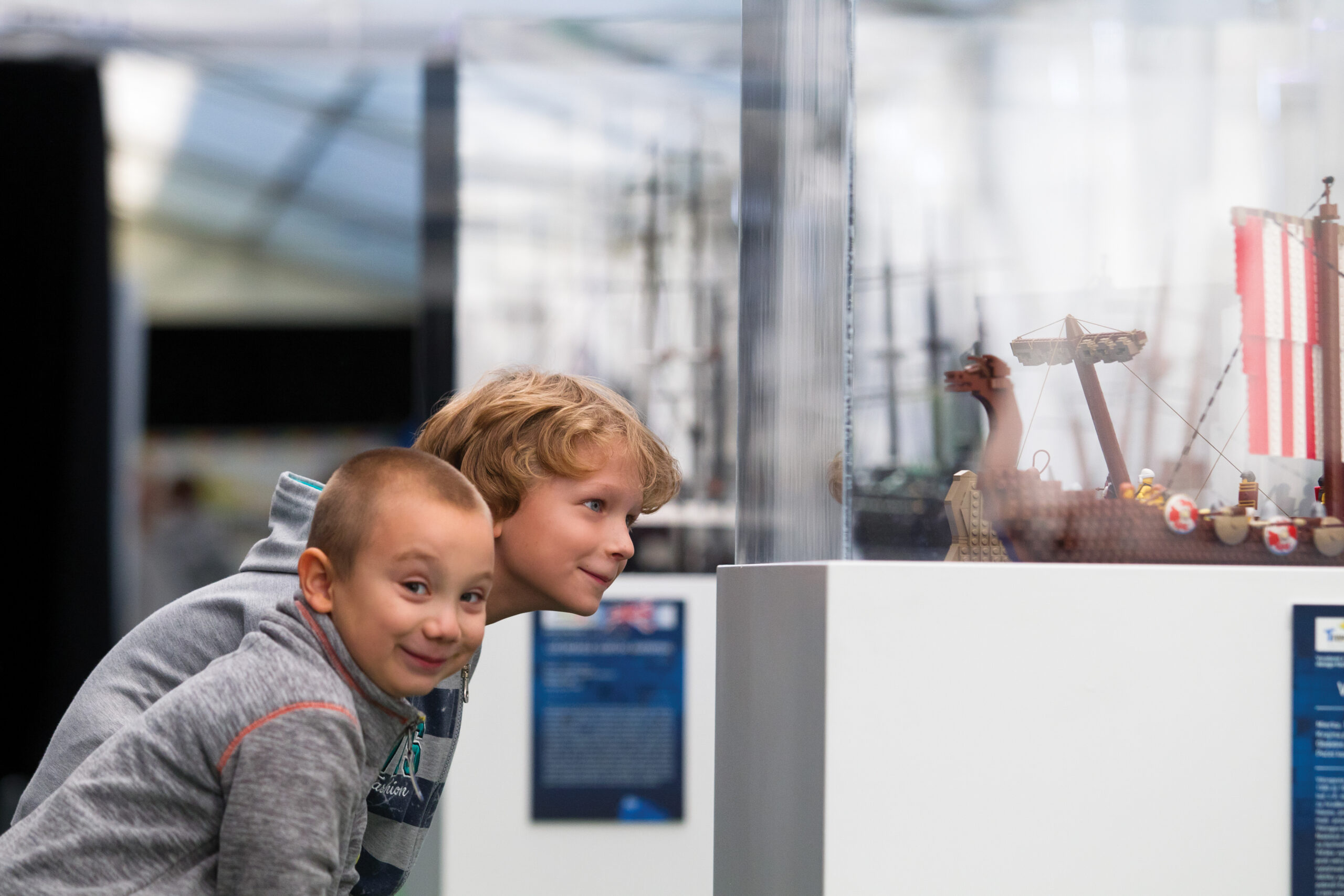
The array of land, air, sea, and space vehicles is wide and deep, ranging from a 2012 Lamborghini Aventador used by police in the United Arab Emirates to a 1959 Triumph Bonneville motorcycle to a Viking Longship. Just as compelling are a Chinese Junk Boat, the HMS Victory from 1805 and a 1602 sailing carriage, designed to drive on land using wind power.
Surely such creations were beyond the imagination of Ole Kirk Christiansen, the Danish carpenter who began making wooden toys in 1932 and switched to plastic in 1947. Two years later, his company introduced the first interlocking blocks, and a durable new toy world was born. “It wasn’t until the 1970s that they began packaging Lego bricks in sets,” Kemper says. “The first sets were Star Wars and were very popular.”
Environmental concerns
Another thing Christiansen couldn’t have foreseen was the environmental impact of the plastic used to make the bricks, which don’t biodegrade and aren’t recyclable in a traditional sense. The company’s attempt to create bricks from recycled bottles fizzled out when it was determined the process had a higher carbon footprint than the original plastic method.
One solution, as any parent of a Lego-loving kid can attest, is passing on Lego bricks to younger generations via schools, daycares and such. Businesses such as Bricks and Minifigs buy, sell and trade bricks, thus keeping them out of landfills and putting them back into the hands of future brick creators.
“Traveling Bricks” will undoubtedly delight current Lego users, but it will also intrigue the adults who accompany them. It’s enough to make your jaw drop to learn that the largest tire maker in the world is the Lego Group, who produce more than 300 million per year.
And chances are, few of us have seen a 1938 Mallard A4 streamlined steam locomotive with Art Deco design elements. Not only beautiful, the U.K.-built locomotive was notable because it reached a top speed of 125.88 miles per hour and broke the world speed record.
Now, thanks to the Virginia Museum of History and Culture and 4,800 blue Lego bricks, the Mallard is right there for all to admire.
“Traveling Bricks” runs through Jan. 5, 2025 at the Virginia Museum of History and Culture, 428 N. Arthur Ashe Blvd. Virginiahistory.org