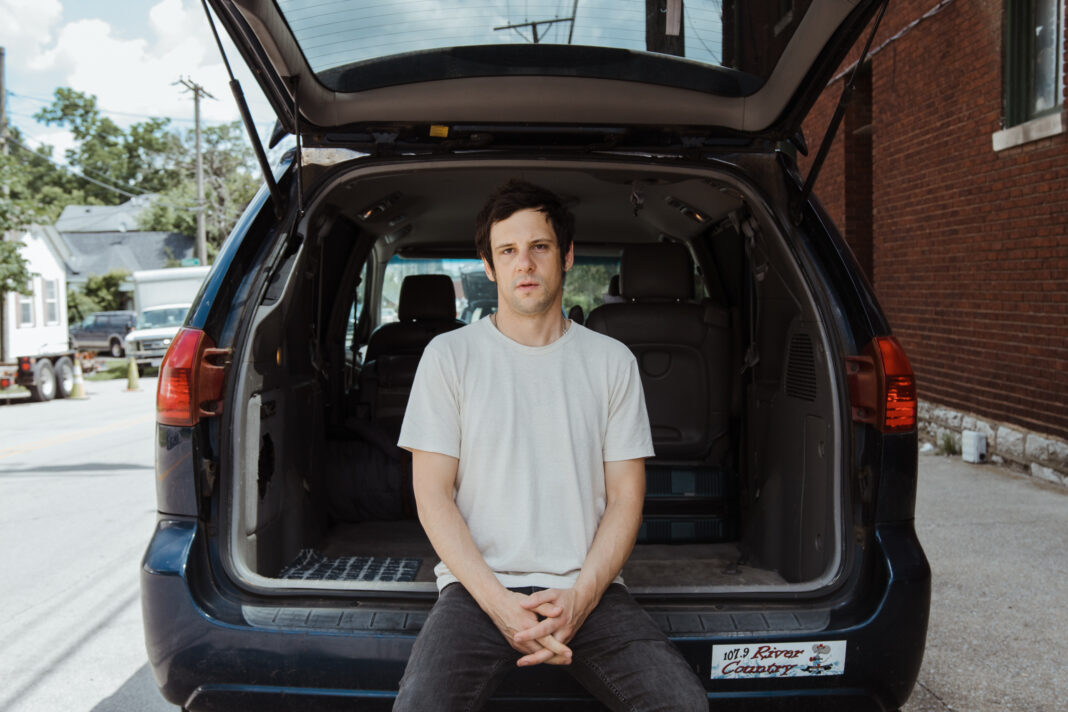
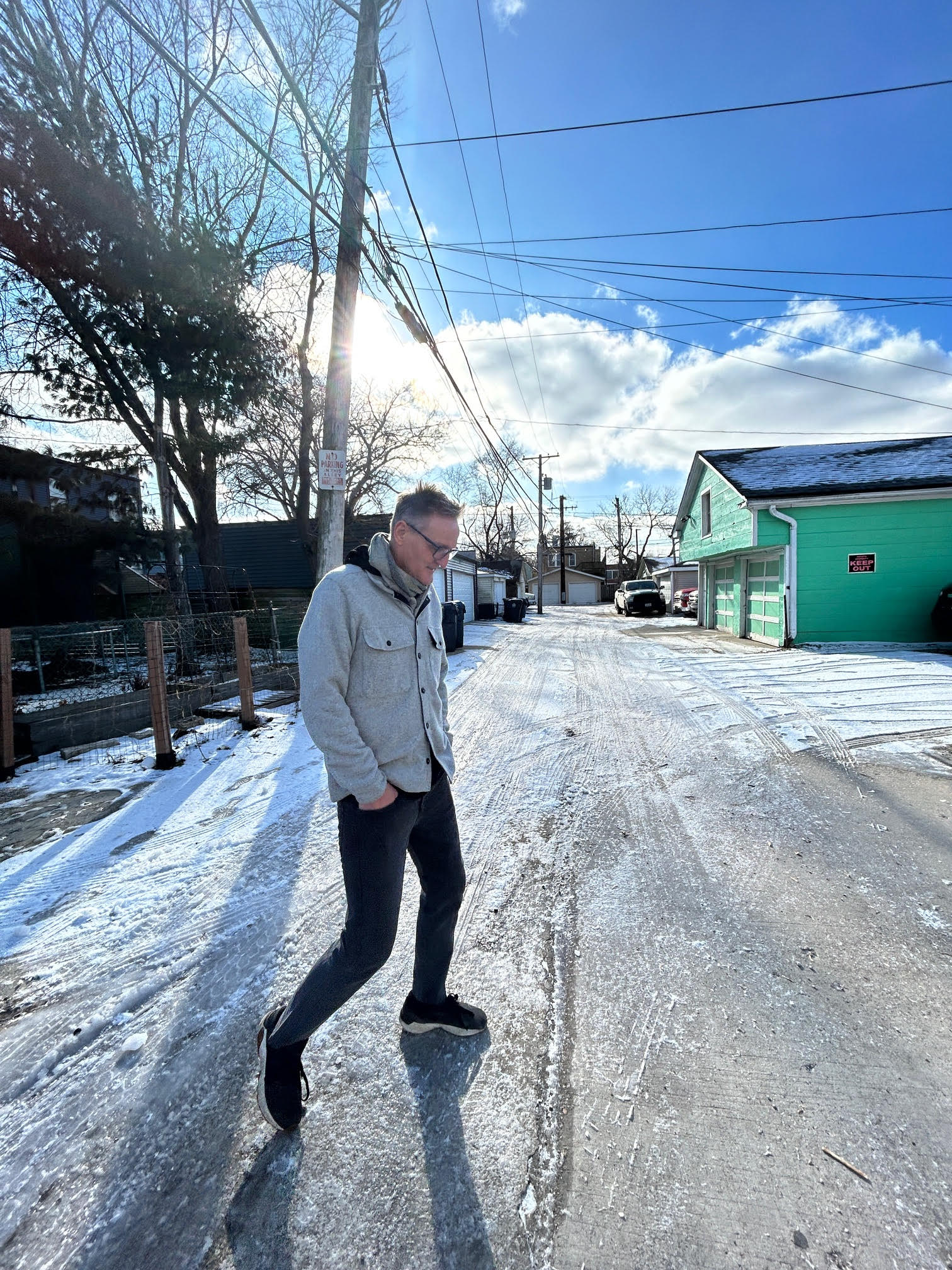
“I very rarely feel that I need to finish something quickly,” Mark Nelson says over a Zoom call from his home in Evanston, Illinois. “I’m happy with something sitting for years at a time, in some cases.”
The musician behind long-running ambient project Pan•American and guitarist of legendary Richmond drone band Labradford speaks in an unhurried cadence, mindfully interrogating each idea as it arises. Occasionally, he interrupts himself mid-thought, eyes roaming to the middle-distance above his head as he pauses to delete and rephrase an idea. Nelson’s carefully constructed paragraphs mimic the way he records music, which he describes as a cyclical process of constant building and deconstruction. Sometimes, he finds the best move is to jettison the piece altogether and start anew. “It all comes back to patience,” he says definitively.
This patience was instilled in him, in part, during his tenure in Richmond. “Time unfolds there a little differently than elsewhere,” he says, recalling the dreamy tempo of his decade-plus in the River City. “It felt like there was more time there, more days and more hours to do things that you want to do.”
After graduating high school in Northern Virginia and spending a few years living in Germany, where his father was stationed as a Foreign Service Officer, Nelson moved to Richmond in the early ‘90s to attend Virginia Commonwealth University. He and keyboardist Carter Brown formed Labradford in 1992 and issued their first album, “Prazision,” on Kranky two years later. Bassist Robert Donne joined shortly after its release, and for the next eight years, the trio would become one of the most quietly revered post-rock and drone outfits of their time. Their music unfolded with the slow grace of a bike ride on a humid day, shimmering like sunlight filtering through a windblown canopy.
After Labradford went on a permanent hiatus in 2001 and Nelson decamped to Chicago, he focused primarily on exploring every corner of ambient music through Pan•American. Across his nearly three-decade discography, starting with a dubby, glacial eponymous record in 1998, Nelson has dabbled in minimal techno, acoustic drone-folk, rural psych transmissions and manipulated field recordings. His latest, “Fly the Ocean in a Silver Plane,” is a gorgeous combination of drum machine pulses, twinkling guitar loops, ghostly vocals, and plaintive violin courtesy of fellow Chicago experimentalist Mallory Linnehan. At no point do any of its elements settle or sit still, a feeling you can trace back to one of the record’s main influences, Chuck Berry’s anxious, cross-country travelogue, “Promised Land.”
A loose theme of travel winds through “Fly the Ocean,” the mechanics of which we dance around during our hour-long conversation. In a text message shortly after the interview, Nelson lands on the most succinct version of the album’s guiding idea: “I think the travel metaphor really comes down to an acknowledgment that we don’t choose our time and place, but this is the space we’re given to be up in the air of consciousness. Easy and justifiable to get lost and to despair in the cultural moment, but this is the time we’ve been given.” With Pan•American, Nelson aims to find and document the most meaningful moments of our lives, the fond memories or profound epiphanies that echo long after the music stops.
Pan•American plays Révéler on Sunday, March 29, as part of the monthly Sunday Soundtracks electronic music series. Doors open at 7 p.m. with the show at 7:30 p.m. UPDATE: This show is sold out.
Style Weekly: How much of working on a Pan•American record is a process of discovery versus a process of executing an idea — finding a song versus writing the song?
Mark Nelson: I don’t think about writing songs or set out to find something new; it’s just a process of playing and exploring. I’m not particularly goal-oriented, so if something emerges, it emerges. Most ideas and melodies originate from the daily practice of playing an instrument, and this record, in particular, nudged me back towards some electronic stuff that I hadn’t been messing with as much in the last few years. I spent a lot of time in the last couple of years working on some collaborations with Michael Grigoni and Kramer, so a lot of little things were piling up in the background that I wasn’t focused on. When I thought, Maybe it’s Pan•American time again, I had this little collection of pieces I liked.
Giving it space to go in different directions is important, as is understanding when it’s not working and understanding when it’s done. I think everyone knows talented, creative people who have a real paralysis about finishing things. And if I’m good at anything, I’m good at finishing things. I’m good at deleting things. That keeps the soil pretty vibrant.
Do you record everything that you play during this daily practice?
No, it’s mostly just playing acoustic guitar or something like that. Sometimes I do Voice Memo stuff, but I’m terrible at it. Jeff Tweedy has talked about doing that and having the patience to go back to the voice memos. He credits that with being as prolific as he is. I think just about everyone has lots of ideas. Good ideas are easy; it’s prioritizing, scheduling, and editing that are the complicated parts.
I’ve worked on guitar stuff a lot for the last 10 years or so, trying to be kind of good. [Laughs] It occurred to me at some point that I’d put out a bunch of records, but I didn’t even have an intermediate level of understanding the instrument. So, I play to get at least a little better technically and gain a greater understanding, not with the goal of creating records, but for my own enjoyment.
How do you know when something is done?
If I can’t fix anything more on it, I’m happy with it. I acquired some skills, probably from having children, that enable me to work on something for 10 minutes a day and leave it. Wake up in the middle of the night and go listen to it again to see where it is. If I can listen to it and not want to change anything, that’s when I know that it’s as done as it can be. Though there are plenty of times when you get to that point, and it’s like, “Okay, it’s finished.” Two weeks later, it sounds horrible. [Laughs]
What does it feel like when you reach that point where there’s nothing more you want to do to a piece? Some people have a synesthetic reaction, or some people, like Richmond producer Ohbliv, experience physical things like heart palpitations.
The closest it would be is a certain calm. The anxiety of editing and mixing, trying to change or fix something, is gone. When that’s gone, the problems feel solved. It’s not like when Jay Z and Timbaland recorded “Dirt Off Your Shoulder,” where they just knew they had a fucking massive song right then and there. That’s not really the feeling. It’s more like, There are no more problems here. This represents this time and my best effort.
Two songs helped shape this record: Chuck Berry’s “Promised Land” and Jo Stafford’s version of “You Belong To Me,” which is where the title comes from. What was it about “You Belong To Me” in particular that you wanted to explore with your work?
It embodied many of the ideas in the record — uncertainty and travel — and it is this very lush, charming surface, with a lot of anxiety and tension underneath. It’s a song I’ve always loved, and I like that phrase [“fly the ocean in a silver plane”], so I reverse-engineered it to be an influence. [Laughs] It’s interesting to me to give people something that doesn’t seem like an obvious fit, and then give them the opportunity to make their own connection there.
One of the things I’ve been thinking and talking to people about is what does it mean to have all the music in the world right here? [Holds up his phone] Is it good or bad? I tend to think that for musicians, it’s been a net positive, even though musicians are the ones who complain about it the most. I mean, that exposure, that potential reach is unreal when you think about what it was like 20, 25 years ago. But for listeners, having access to everything is a net negative. When you have fewer inputs, you’re put in a position to make more connections between the few things that you have. You don’t ever have to connect one thing to another when it’s a never-ending fucking stream. When I was in high school, if I had a record by X and I had a record by Thin Lizzy, and I couldn’t get every other record in the world, those two things somehow had to interact.
Travel is one of the record’s main themes. What’s the destination?
Well, ultimately, the end of life is the destination. We’re all on this journey, and not to be too trite, but we’re all on this journey together. It is a shared experience. Now, at a certain age, it’s hard to get ready to come to Richmond to play a show without thinking about friends of mine who lived there and aren’t here anymore. I think at its macro level, that’s the metaphor.
It does feel like there’s a lot of grief or death acceptance here. At least three song titles overtly mention death: “Death Cleaning,” “Heaven’s Waiting Room,” and “Entrance to Afterlife.”
I don’t think death was on my mind so much as the reminders that we don’t have infinite time here. That’s probably a function of age and experience. As a younger person, I had a more naive sense that things would basically be fine. And now, given the state of this country, I don’t expect to see things being much better in my lifetime. You think that in the time that you’re here, humanity has moved forward and made these improvements, and that consciousness has grown somehow. I don’t assume that anymore. What we have, then, are these moments, these interactions, and the people around us who we care about. It really is that simple, you know?
There are only a couple of instances of lyrics on the record. On “Death Cleaning,” it sounds like you sing “You can go,” and then at the end of “Golden Gate, Silver City,” it’s your collaborator, Mallory Linnehan, singing, “I know you want me to.” Is that a conversation that’s happening across this record?
Yes, you could say that. I’ll certainly admit to having a pretty healthy appetite for nostalgia and sentiment, and that’s represented in that last song, for sure. It’s for the people who aren’t with us anymore, whether permanently or temporarily. Owing them some remembrance seems a worthy gift to offer for what they’ve been in our lives.
In both cases, it was an instantaneous decision to keep those lyrics. On “Golden Gate, Silver City,” Mallory had done two or three tracks of improvised vocals, and I ended up editing out everything except that one. That line seemed to resonate, and I liked having it right at the very end. There is almost a way that it wraps back on itself, that the end of the record speaks to the beginning of the record.
“You think that in the time that you’re here, humanity has moved forward and made these improvements, and that consciousness has grown somehow. I don’t assume that anymore. What we have, then, are these moments, these interactions, and the people around us who we care about.” — Mark Nelson
The longest song on the record is four-and-a-half minutes. Did they exist in longer forms that you had to whittle down?
It’s more at the front of my mind to keep things shorter now than it used to be. That’s a bigger priority, aesthetically. So, I definitely do end up shortening things more and more. That’s fundamental to editing. When is it short enough? Is the idea represented and not repeating itself? That’s something that I’m pretty focused on now. Working with Kramer, he’s much more comfortable with longer ideas. There’s a little tension there because I’m always lobbying to shorten.
What it comes down to, and I’ve articulated this to myself in the last couple of years, is I’m not as interested in what the music does to a listener when it’s playing. For me, the goal is to leave a trace afterwards. If it has value for someone, it’s in what it opens up and in what’s left when it’s over. Some music is designed to bring you into that moment — maybe metal or dance music are good examples — where there’s that immediacy. With what I try to do, and maybe ambient in general, if we can use that blanket term, is leave something lingering in your consciousness when you’re not listening to it.
I think a lot about attention spans and how, over the past 20 to 30 years, they have shrunk so much, partly because of the overload of the internet and partly because of capitalism’s demand to expand and increase productivity, which shaves down the time we have for anything else. The idea of creating a space for someone to inhabit and connect with what they’re feeling, or didn’t know they needed to feel, all within four minutes, is an interesting challenge.
The presence of everything, at any moment, at all times, in your pocket, creates this sense of I need to be doing this. I need to be hearing this. I need to be listening to one of 5,000 episodes of this podcast. If you can disconnect from that as an artist, if you can get into that space and switch off that anxiety in someone’s brain, and they take the earbuds out, that seems like a great success.
The travel theme and way the album feels make me think of Brian Eno’s “Music for Airports.” Eno talked about making that record partly to take his and our minds off the impossibility of air travel, but also to create sounds that made the listener feel lifted, held, or suspended in the air. Every little element on “Fly the Ocean” seems to be in constant motion, yet strangely calm. How do the sounds themselves on this record relate to the psychology or the sensations of travel?
It’s interesting that you bring up “Music for Airports,” because I hadn’t drawn that connection before. One of the things Eno said about the origin story of “Music for Airports” is that he’s sitting there thinking, What would be better than what I’m hearing? What would be better than this Euro-disco or whatever that’s coming out of the kiosk? One of the criteria was that frequencies wouldn’t compete with the human voice, because you need to hear the announcements. That’s probably not a factor anymore, because you get the announcements on your phone. But you want to have an open space in the frequency range. Also, there is this feeling in travel and in airports of anxiety: What if the fucking plane crashes and I die? So you want music that’s a little comforting.
I’ve always been uncomfortable with experimental music as a concept. I’m not talking as a genre necessarily, because that’s a different thing, but for something to be experimental implies that you need some information at the front end. You need some context to understand what’s going to happen next. I don’t want the music to need any explanation. If you’re listening to it, you don’t need to wonder why a certain sound is happening in a certain way. It has its own human logic. That’s a roundabout way of trying to answer why the sounds are what they are, but I wanted things that feel human, recognizable, and ultimately comfortable. But every once in a while, there’s something that brings a different tension to the music. That was a classic Labradford trick: to have a drone set against a vocal or a higher-frequency sound. And that even feeds back into the idea of having shorter songs: you want to present the idea, slightly upset the balance, and get out. Leave the mark that you’ve made.
Pan•American with Stephen Vitiello and J&R’s Music World takes place at Révéler Experiences in Carytown on Sunday, March 29, as part of the monthly Sunday Soundtracks electronic music series. Doors at 7 p.m., show at 7:30 p.m. The show is sold out.