One of Robert Rauschenberg’s most famous artworks was created through an act of destruction.
In 1953, Rauschenberg approached abstract expressionist Willem de Kooning and requested a drawing that he could erase. The elder, established artist consented, and Rauschenberg spent two months painstakingly erasing the work. Placed in a gilded frame with an inscription by Rauschenberg’s lover and fellow artist Jasper Johns, “Erased de Kooning Drawing” became one of Rauschenberg’s most celebrated and controversial works.
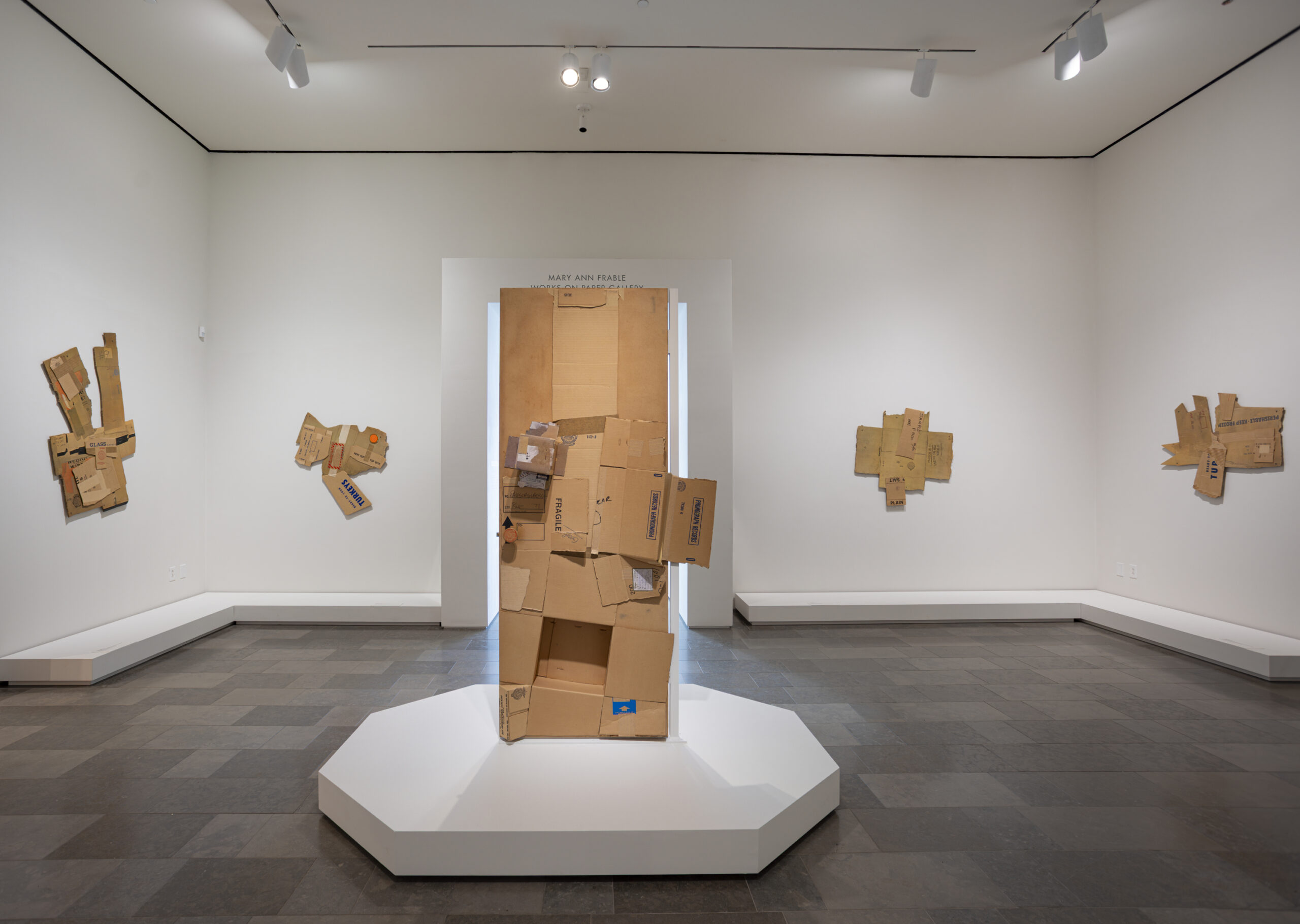
A similar sense of mischief can be found in Rauschenberg’s “Cardbirds,” a series of works inspired by cardboard boxes. The editioned works are currently on display at the Virginia Museum of Fine Arts’ Mary Ann Frable Works on Paper Gallery. Owned by the VMFA, the works were last displayed in 1980.
“They debuted here back when they were pretty much made” in 1971, says Valerie Cassel Oliver, the Sydney and Frances Lewis Family Curator of Modern and Contemporary Art. “We’re very fortunate to have these editions gifted to the museum.”
A native of refinery town Port Arthur, Texas, Rauschenberg was a prolific painter, photographer, choreographer, printmaker, set designer and composer. Throughout his career Rauschenberg continuously pushed the boundaries of art and probed consumerist culture for its potential beauty. His work served as a crucial link between abstract expressionism and the pop art movement that followed.
“Very early on, Rauschenberg challenges the kind of capitalist system of art and art commerce,” Oliver says. “It’s a moment in the post-World War II years where the artists are beginning to rethink how they move through the world and what they have to say.”
Though Rauschenberg wasn’t the first to make art from everyday objects and junk on the street, he championed the idea that these items could be beautiful.
“I really feel sorry for people who think things like soap dishes or mirrors or Coke bottles are ugly,” he once remarked, “because they’re surrounded by things like that all day long, and it must make them miserable.”
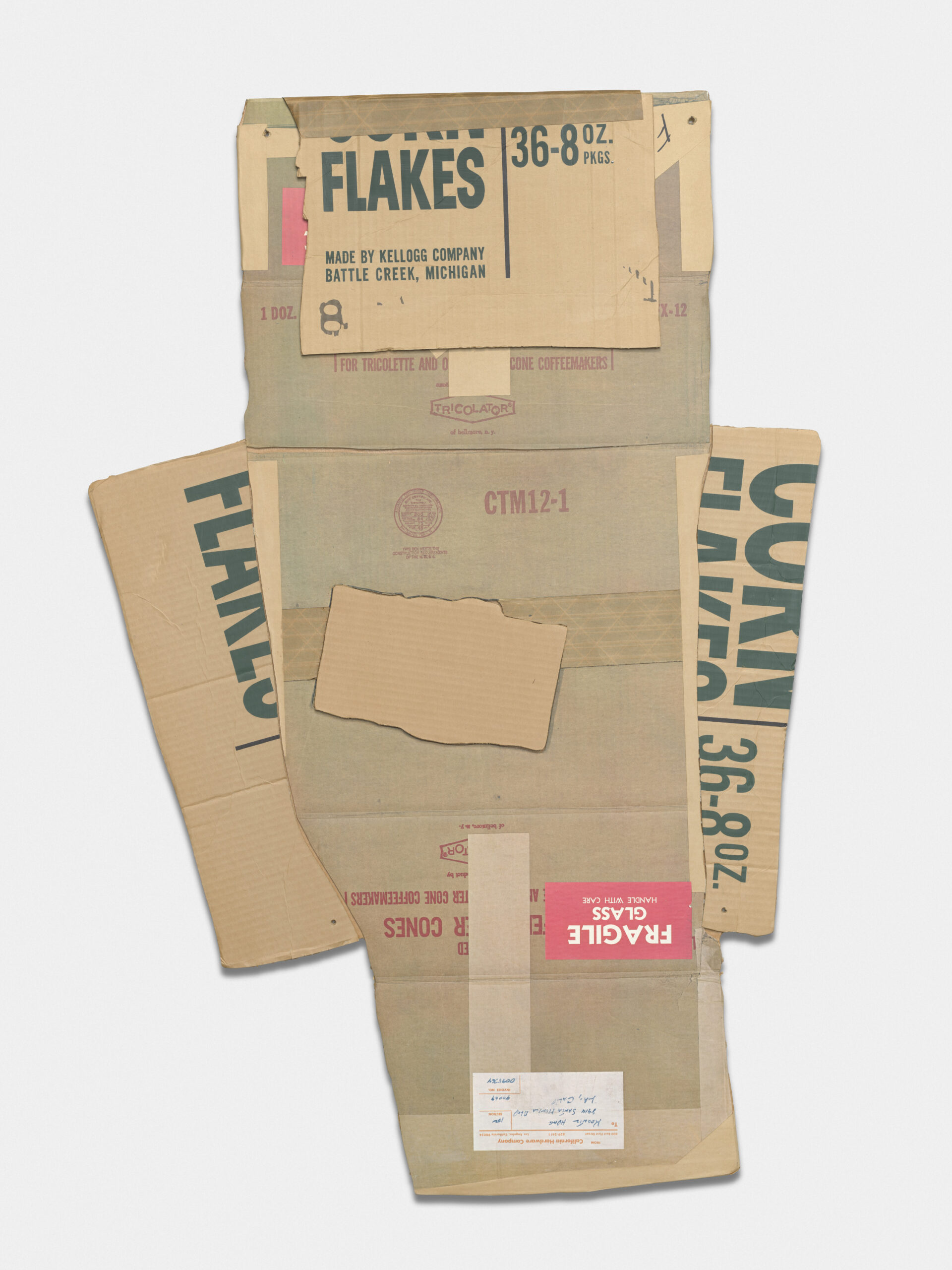
The “Cardbirds” series recreates flattened cardboard boxes that Rauschenberg found in dumpsters near La Cienega Boulevard in Los Angeles. In these works, the viewer can find birds, an anglerfish, even a door. Printed at artist workshop Gemini G.E.L., the series painstakingly recreates the labels, torn edges and folds of the original castoff boxes. The trompe l’oeil effect is so convincing that “Cardbirds” are often mistaken for actual cardboard boxes.
“Rauschenberg was very thoughtful in the composition,” says Oliver, noting the painstaking recreation of stamps and packing tape found on the boxes. “He was not only a painter and a sculptor; he also studied graphic design, so it was a no-brainer to work with Gemini to create facsimiles of the cardboard works.”
Oliver favorably compares these works to folk and vernacular art.
“I love the idea of reintroducing a kind of intellectualism that’s very intuitive into that narrative,” she says. “Here is Rauschenberg coming and picking up on these things and these ideas to transform ordinary objects into extraordinary things. That cements his status in the contemporary art field in the 1960s and the 1950s, and it just progresses onwards to this series.”
“Cardbirds” follows Rauschenberg’s earlier “Combines” series that saw the artist merge elements of painting and sculpture to create hybrid three-dimensional works. “Bed,” one of his most famous “Combines,” was created from splashing paint across a well-worn pillow, sheet and quilt. Taking a page from Marcel Duchamp, Rauschenberg enjoyed challenging the meaning of art itself.
To celebrate the upcoming centennial of Rauschenberg’s birth in October, the VMFA will host a performance by composer and musician Ellen Fullman accompanied by the New York-based JACK Quartet. Fullman will perform a newly commissioned work on a musical sculpture she created called the Long String Instrument. Fullman will also reprise an earlier Rauschenberg-inspired work called the Metal Skirt Sound Sculpture. The performance is funded by the Rauschenberg Foundation and will take place Jan. 23, 2026.
At a time when some of the VMFA’s galleries have come offline as the museum readies for the largest expansion in its history, Oliver says rediscovering the “Cardbirds” series in its archives has been a happy surprise.
“It seems like an apt moment to reintroduce the idea of what is art and what can become art and how artists play on that idea,” she says. “It’s really been a joy to dig into our archives, look back into spaces where we presented before. Just to get a sense of looking back in order to frame what we’re doing going forward.”
Oliver brings up the Ghanaian principle of Sankofa, a term for reflecting on the past to create a better tomorrow: “My department has been actively doing that, [looking at] what has been in their past to see what resonates in our moment and what could point us towards the future.”
“Robert Rauschenberg: Cardbirds” is on display through Jan. 26, 2026, at the Virginia Museum of Fine Arts, 200 N. Arthur Ashe Boulevard. For more information visit vmfa.museum.