
Paul Thomas Anderson’s “One Battle After Another” is a whole lotta movie. Think a chase-and-siege thriller and a daffy comedy and a socio-politically freighted romantic triangle and a government satire and two or three of the best action movies in decades run all at once for 161 minutes. It has a swagger that we haven’t seen from Anderson in some time. To see him playing boldly in so vast a sandbox is exhilarating.
Even as a rapt admirer of Anderson’s, I can admit that his turn towards cryptic auteur in the early aughts seemed intended to shut people out. He was not always a pseudo-Kubrickean formalist with a weakness for Thomas Pynchon. “Boogie Nights” from 1997 is an open and generous movie-movie, with poetic flourishes and unforgettable characters and its heart on its sleeve. Since the mixed reception of 1999’s “Magnolia,” perhaps, Anderson has been tilling the soil of alienated America, with wrenching yet insular studies of characters that are determined to suppress the vulnerability of his early work.
“One Battle After Another” has the swing of “Boogie Nights,” though that exaltation is filtered through anxiety over the modern American hellscape, and tempered by the mastery that Anderson has achieved over the last 30 years. It grabs you by the guts and it moves. The filmmaker isn’t just sending his bat signal out to cinephiles, he’s aiming for a pop cultural touchstone and working with enormous, big studio resources.
The plot is a reworking of Pynchon’s “Vineland” relocated to modern day, marking “One Battle After Another” as Anderson’s first contemporary-set movie since “Punch-drunk Love” in 2002. The French 75 is a group of revolutionaries at war with the government, freeing people from detention centers on the Mexican-American border and robbing banks to fund the enterprises. The French 75 is primarily a Black group, with the ferocious Perfidia Beverly Hills (Teyana Taylor) at its center. Somehow, there’s also Bob (Leonardo DiCaprio), aka Ghetto Pete, a white boy who’s in love and lust with Perfidia.
In the opening sequence, a raid on a camp at night that rates as one of the most intense and muscular set pieces in Anderson’s canon, Perfidia takes captive Col. Steven J. Lockjaw (Sean Penn), an all-white man’s man who sees the prisoners only as “illegals” and rapists and drug peddlers. In other words, Lockjaw is a guy who is working towards Making America Great Again. He and Perfidia fall into an obsessive sexual imbroglio with a thicket of nesting fetishes.
Lockjaw fetishizes Black women, or maybe just this Black woman, while Perfidia fetishizes her power over a man that represents everything she loathes and who nevertheless himself emits a profound sense of power to rival her own. Lefties settling in for a fun and easy MAGA satire might find themselves twitching a little here, as they might at the film’s jabs at smug leftie ineffectuality. This is sex and politics and race and all sorts of other taboos mixed together and staged real hot, with the neuroses and the horny power dynamics of Anderson joints like “The Master” and “Inherent Vice.”
Anderson is picking at something here that has always been present in his work: the divide between our belief systems and our inherent selves. This is a pertinent theme now, with politics as a literal blood sport meant to keep us angry and afraid and hopeless and perpetually hating each other. But we are both more and less than the sum of our stances, whether we wish to be or not. Platitudes and even richer political convictions cannot paper over the contradictions of our humanity.
Cut to 16 years later: Perfidia is in the wind, the French 75 is disbanded and hiding, while Bob raises Perfidia’s teenage child, Willa (Chase Infiniti), who may or may not be his own. Bob has become a burnout in the key of Lebowski, drinking and smoking weed to Willa’s consternation. They are somewhere out in the Northern California woods, surrounded by junk that obscures secret passages. I could’ve used more texture about Bob and Willa’s life in these woods; Pynchon spent a lot of time — at least half the book — on it.
Meanwhile, Lockjaw has become a celebrated general, leading his troops on raids in sanctuary cities in the sort of displays of authoritarianism that now bore us in the daily news. He is hoping to join an elite cabal of rich white nationalists who run the country [called the Christmas Adventurers Club], but first he must be sure that any evidence of his own racial disloyalty be put to bed. Lockjaw comes after Bob and Willa, initiating a fraught chase across the west.
Anderson is picking at something here that has always been present in his work: the divide between our belief systems and our inherent selves. This is a pertinent theme now, with politics as a literal blood sport meant to keep us angry and afraid and hopeless and perpetually hating each other.
Remember that scene in “Punch-drunk Love” when Adam Sandler is handling a mishap at work while every other stressor in his life bears down on him simultaneously? In “One Battle After Another,” Anderson maintains that nerve-racking energy for two hours. Bob and Willa become separated with Lockjaw in pursuit, with Bob and Lockjaw serving as dual protagonists, elucidating two very different points of view of modern America.
Anderson accepts as a given America as a military-scape. No mainstream movie has been this damningly upfront and casual about I.C.E. and those camps. Characters walk in and out of camps in spellbinding tracking shots as children play with inflatable toys in cages. Any hack could show the children being miserable; but Anderson, an artist, shows more than victimization. They are here, but children still play.
“One Battle After Another” explores this country’s drift into nihilism while remaining exuberant and alive. That’s its defiant magic trick.
Bob sees America as a terrifying place, as Lockjaw reduces a town to chaos in a matter of hours. Lockjaw sees America and is also, well, terrified. His evil is played both satirically and earnestly. Penn’s performance is probably going to be the most divisive element of a movie that is sure to piss off people of a variety of sociopolitical persuasions.
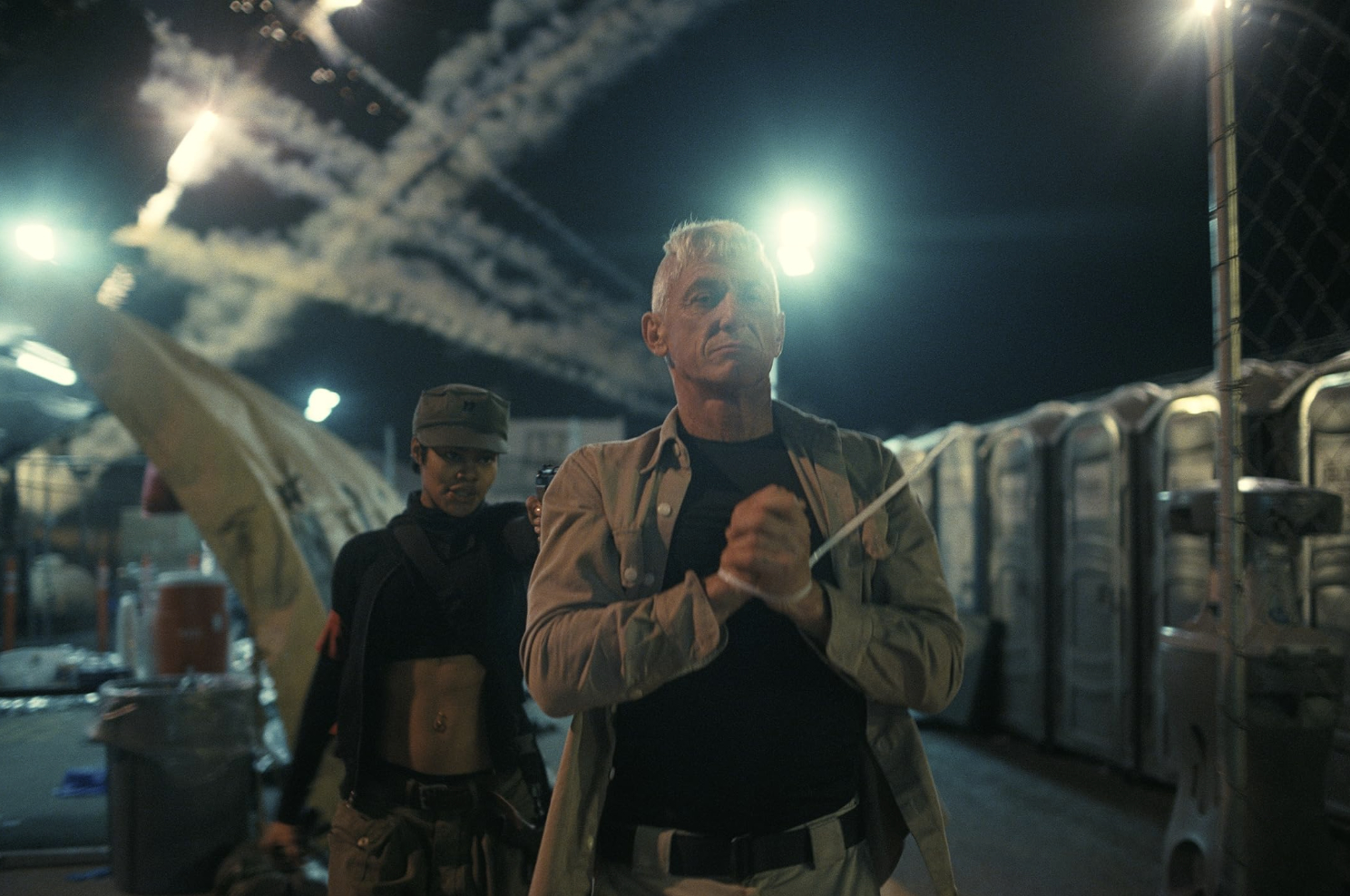
Penn is extraordinary; turning a potential cartoon of MAGA evil into a person locked in a prison of hatred and stifled by longings for connection. Lockjaw is a classic Anderson man-child, looking for a belief system to tame his self-loathing. It’s a stylish and daring performance, broad and specific and mysterious all at once. Picture Sterling Hayden’s character in “Doctor Strangelove” played for tragedy.
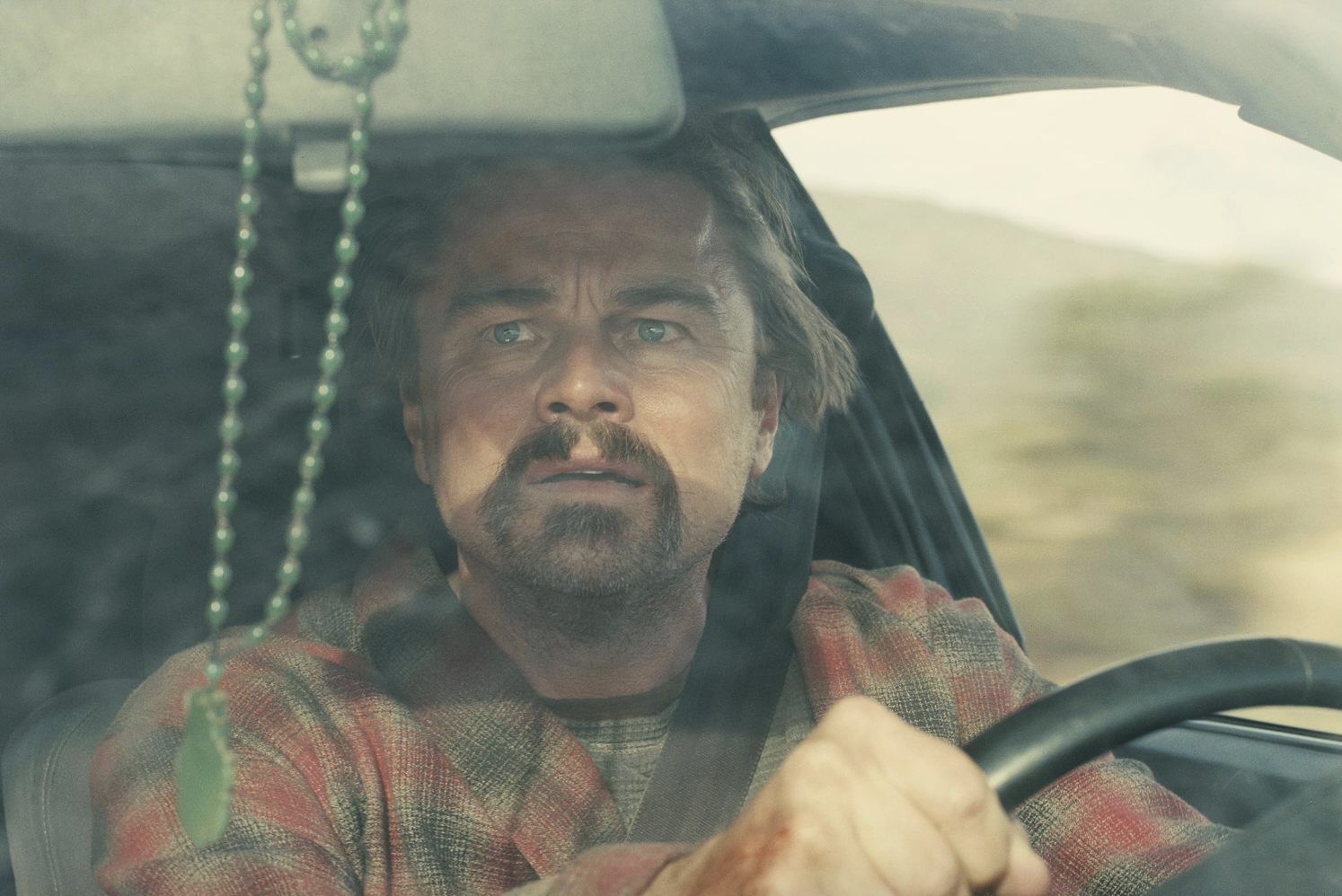
And Bob is DiCaprio’s best performance since “The Wolf of Wall Street.” The actor is always best when he’s allowed to be funny, when he’s able to put prestige aside and seemingly exorcise himself. His unmistakable resemblance to Jack Nicholson here, which was also apparent in “Wolf,” intensifies this movie’s very 1970s-era vibe.
Nicholson and DiCaprio are both comfortable playing men who don’t understand the rules of the game — think of J.J. Gittes’ poignant ineffectuality in “Chinatown.” One of the great and moving aspects of Bob is that he isn’t special, which is why he’s special. He’s essentially a normal guy who wants to chill out and love his daughter, who keeps getting caught in between extremely formidable people. His befuddlement is affirmed by a hilarious running joke, played beautifully by DiCaprio, in which Bob can never remember the passwords to get information from his crew.
“One Battle After Another” is the kind of bountiful cornucopia that can reduce a cinephile to an elaborate game of “and then this happened.” Benicio del Toro appears briefly as Willa’s martial arts teacher and makes sly and resonant comedy of his character’s unflappability. This is a man who helps move hunted people away, who accepts our modern war state as a given, who refuses to let that danger tame his pleasure in life. In a great sequence — which Anderson has the confidence to nearly toss off — a tracking shot keeps revealing new and deeper levels of the martial artist’s fortress and abode, which he navigates with the control and empathy of a master sage.
As in most Anderson movies, the women tend to be forgotten. Willa is a very charismatic MacGuffin. Perfidia disappears early, taking the movie’s most troubling and ambitious psychosexual textures with her. Shayna McHale has an electrifying early scene as a revolutionary with a great, unprintable name, and then disappears. Regina Hall is urgent and soulful and mostly here to serve the logistics of the story. These quick entrances and exits are where the strain of the movie’s too-much-ness is most apparent.
Anderson makes neurotic dude movies, and he digs deeper into dudes and their turmoil than maybe any other contemporary American filmmaker, especially at this scale. Though “One Battle After Another” is full of sharp set pieces, the film’s climax is a real showstopper. As cars pursue one another in a western landscape, Anderson emphasizes the undulating curves of the road, framing the asphalt at eye level and likening it to lulling waves that are punctuated by the full-throated throttle of the vehicles. The sequence is surreal and astonishing and resonant to the theme of divided America.
Bob’s quest for Willa rhymes with our longing to believe in America and with Anderson’s need for real movies to matter. With its enormous landscapes and epic close-ups of human faces, “One Battle After Another” is extraordinarily vivid, a sensory bath that scoffs at the idea of cinema as digital fodder, as “content.” Its existence may impart to you the same qualified hope that Anderson ultimately grants his father-daughter duo in the film’s wonderful final moments. True revolution may begin with belief and especially with hope, which may begin with a sense of home.
“One Battle After Another” is now in theaters everywhere, including IMAX.