Francis Ford Coppola’s “Megalopolis” had been one of the legendary filmmaker’s dream projects for decades, a parable likening America to Rome, with science fiction and Ayn Rand and years of passing fancies thrown into the stew. Edging into his 80s, with no studio willing to front the money, Coppola sold off part of his wine enterprises to fund the film himself for over $100 million. Would this bravado yield another “Apocalypse Now,” a profoundly troubled production that became a classic?
“Megalopolis” was released last autumn, with a Mad Libs cast that mixes A-listers like Adam Driver and Aubrey Plaza and Laurence Fishburne with pseudo-cancelled icons like Jon Voight and Dustin Hoffman with talented, also pseudo-cancelled, recovering train wrecks like Shia LaBeouf. Cinephiles who will forgive an auteur anything gave “Megalopolis” polite notices, while no one else cared.
One of the ironies of Coppola’s career is that it has been defined by his resistance to what he does best: classical studio filmmaking with texture and intelligence. He released the first and second “Godfather” movies as well as “The Conversation” within a three-year span, for Pete’s sake. Even something like “The Rainmaker,” an unassuming adaptation of a John Grisham thriller, is casually acted and directed with a level of fine-grained skill that’s virtually unheard of in modern American cinema.
But Coppola is drawn to the avant-garde, betting his life on ornamental, precious, oft-mythologized passion projects that are usually all tech and concept. The problem with Coppola’s experimental filmmaking is that you can feel him working for it (whereas artists like Stan Brakhage or David Lynch seem to be naturally in tune with their free-associational channels). Movies like “One from the Heart” and “The Cotton Club” have enough theme and aesthetic ambition to drive a hundred term papers, but on the screen, in the moment, they just sit there.
“Megalopolis” is in this tradition. It’s self-consciously bizarre, with an ever-shifting tone that’s destined to be read by New Yorker types as being akin to jazz. In fairness, the movie’s anything-goes extravagance might offer another filmmaker a road towards capturing the mindless, everything-all-at-once dystopia in which we find ourselves. “Megalopolis” both fascinatingly and insufferably suggests what a feature made entirely of memes might feel like. Imagine 135 minutes of Nic Cage memes unified by Coppola’s congratulation of himself as a visionary and you’re close to capturing this movie’s vibe.
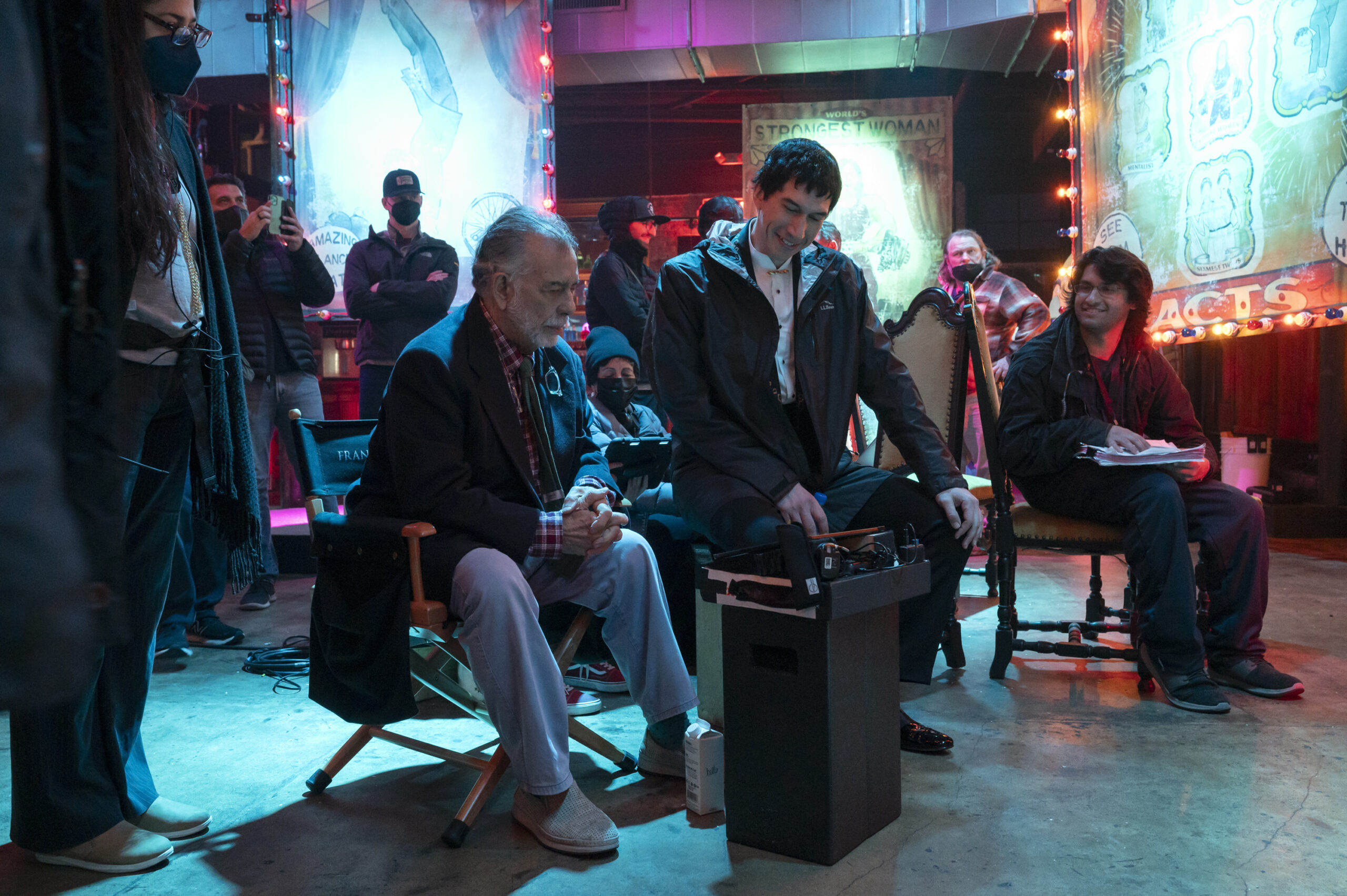
Barely watchable but notable is the kind of WTF movie that begs for a documentary. And here we are with Mike Figgis’ “Megadoc.” Figgis, who has known the Coppolas since directing nephew Nic Cage to an Oscar in “Leaving Las Vegas” 30 years ago, was invited to shoot the filming of “Megalopolis,” from actors’ rehearsals to trouble with special effects to its premiere at Cannes last year. An acclaimed filmmaker filming an icon is irresistible, and “Megadoc” has a chilly, dryly amusing power.
The sharp and newly trim Coppola is the star here, and he’s more or less what you probably expect: the resident genius as temperamental father figure and ringmaster, alternately empathetic and ornery, annoying and poignant. “Megalopolis” detractors will feel vindicated by all the adoring actors, eager to work with Coppola, who clearly have no idea what the script is supposed to mean. LaBeouf, who is energized by confrontation, relentlessly challenges Coppola who, while irritated, probably brought the actor on for this very treatment.
The ongoing dust-ups between Coppola and LaBeouf animate the driving duality of the “Megalopolis” production, which speaks to the differing reactions that people had to the finished film. Coppola is after something modern, intuitive and fluid that values form over narrative, while LaBeouf is an old-school, stories-and-character-development guy who expects things to make a scintilla of rational sense.
There’s comedy in watching the younger, crazier guy of questionable repute argue with an aging master in favor of tradition. LaBeouf is the kind of artist who needs to know why his character would cross the room in a certain way, when Coppola wants the damn shot. It’s easy to watch these behind-the-scenes nuggets and sympathize with both men.
“Megadoc” is at its best in these kinds of sequences, which are distinguished by granular details that pertain to the actual act of making movies. Figgis does not prioritize banalities driven by a PR firm. Anyone who has made art, or been around any kind of art-making, knows what the creative process is first and above all: work. The fellow art-maker Figgis understands that truth and puts it across the screen here. That said, “Megadoc” at a certain point could use some gossipy juice; ultimately it doesn’t feel candid enough. That’s regrettable, though not a deal-breaker.

Watching “Megadoc,” I became sympathetic to “Megalopolis.” It’s as if Coppola’s film was meant to be viewed through the prism of Figgis’ documentary. Seeing individual sequences from Coppola’s film here, divorced of the tedious plot machinery of the script, allows one to appreciate their beauty. You will be watching actors fight or sit around the set bored and then there will be a moment of sublime poetry that blends operatic acting with silent-movie tech with a modern sense of scale.
Merging “Megalopolis” with bits of the context of its creation completes it, bringing to life the spirit that feels only half-conjured in the Coppola joint. Or if you want it less woo-woo: blending “Megalopolis” with a documentary intensifies the mix tape quality that was always intended. There are more contrasts in the Figgis doc, more hybrids of real and pretend, boring and transcendent. “Megalopolis” may feel unfinished because the movie was less the point for Coppola than the ecosphere inherent to making it.
Frustrating though it can be, I’ll always take crazy poetry like the Coppola movie over something as dry and polite and monumentally slow as “The History of Sound.” It’s one of those films that appears to have grown out of a ‘just add water’ Oscar-bait kit.
Per the Internet Movie Database, “The History of Sound” is about two men during World War I who set out to record the lives, voices, and music of their American countrymen. That premise, which sounds intriguing, is virtually an afterthought here. The country folk we meet are the usual melancholy, taciturn stereotypes that filmmakers believe all country people to be, and are accorded only a few seconds of screen time each.
The actual source of writer Ben Shattuck (adapting his story) and director Oliver Hermanus’ interest is the forbidden love between the men. Lionel (Paul Mescal) is a guy with perfect pitch who meets David (Josh O’Connor) at university, where they fall into bed and bond over their love of mountain music. Complementing Lionel’s perfect pitch is David’s photographic memory. The years pass, wives and children enter and exit the picture, and elderly Lionel looks back, narrating his regrets with the starchy nostalgia that one might remember from the voiceover accompanying “A River Runs Through It.”
Robert Redford died recently, and he excelled at what Hermanus is trying to bring off with “The History of Sound” and his prior, also mind-numbing “Living.” Redford knew that he was phenomenally good-looking, and developed a minimal style that suggested that a subtle anxiety was flowing underneath his confidence for the sake of counterpoint. Remarkably, he managed as a director to create an aesthetic that communicated this idea as well, especially in “A River Runs Through It” and “Quiz Show.” Redford made this style of implication and pastoral sadness look easy.
Hermanus reminds you how hard this sort of emotionally submerged atmosphere is to conjure without getting precious or boring the audience (it happened to Redford, too). “The History of Sound” is nothing but tasteful imagery and the fellas talking around their passion for the other. Lionel is a cipher, given little undercurrent by Mescal, who bears a striking resemblance to Harry Potter. Meanwhile, O’Connor is vivid as David, emphasizing the mystery of the character. David always seems to be amused with himself; which is becoming a trademark of O’Connor’s performances. David is compelling, in other words, and so, of course, he disappears for more than half the movie.
The impersonal period atmosphere here is meant to help us forget about “Brokeback Mountain,” which Hermanus quotes often. That movie understood that it was a parable and a melodrama. In “The History of Sound,” Hermanus tries to transcend the cheesiness of his set-up with understatement and winds up with not much of anything.
“Megadoc” is now playing at Movieland, while “The History of Sound” is in theaters everywhere.