“Every day that you go to the grocery store is an election day,” says farmer, activist and author Michael Carter Jr. “It is essential for us to understand that the consumer, as well as the legislator, as well as the farmer, has a responsibility to each other.”
The fifth-generation farmer first met Governor Abigail Spanberger during a pandemic Zoom call when she was his state representative. “She said she’d be interested in visiting the farm,” says Carter. “Coming from a politician, I didn’t really believe that.”
Six months later, Spanberger toured the Orange County, Va. Farm which has been in Carter’s family since 1910. The two have been in touch ever since.

Most recently, Carter was part of Spanberger’s “United for Virginia’s Future” transition team. The committee was made up of CEOs, small business owners, school board members, mayors and more, representing a wide swath of industries from healthcare and technology to government affairs and agriculture.
The transition team’s meetings wrapped up right before inauguration, but Carter says he’s still consulting with the new administration about “policies we want to push forward.”
One of those policies is HB 869, a bill introduced during the 2026 regular session. The bill directs all state agencies to implement a purchase program for local farm or food products “in order to reach a goal by 2035 of 20% of all the food and food products purchased by state agencies being local farm or food products.”
As Carter notes, there are only so many sales a small producer can make at a weekend farmers market. These contracts could prove critical for the success of Virginia farmers.
“If a school is getting a contract for apples, we should be going to Virginia apple growers [who are bidding] first,” explains Carter. “Not Washington state or distributors getting apples from Washington state.”
UVA Dine and Africulture
Carter points to the University of Virginia’s dining program (a division of Aramark) as an example of a state institution prioritizing locally grown food. UVA Dine endeavors to serve food that is “grown, raised, or caught within 250 miles from [university] grounds or sourced from an independently owned business within 250 miles from grounds.”
This locally sourced mission is thanks, in part, to the work of Carter’s nonprofit, Africulture.
One of the primary objectives of Africulture is to provide support through marketing, technical assistance and more, to historically underserved and marginalized farmers, guiding them through USDA opportunities and programs.
A collaboration between Africulture, UVA and Aramark resulted in the creation of a Black Farmer Fund which provides a platform for Black farmers in addition to other local, small-scale famers to “find better markets and improve their profitability.”
In addition to his Aramark connection, Carter has also been teaching the Africulture: Roots of US Agriculture course at UVA for the past four years. The course focuses on how the “principles, practices, plants and people of African descent have shaped US agriculture.”
In his class, “Students are assigned to create or identify a problem in the food system and present solutions for that problem,” says Carter. “In the process, they are encouraged to not only come up with their idealist solutions, but to also talk to industry leaders.”
Carter doesn’t assign homework. He hopes his students will learn how to come up with out-of-the box ideas and will be willing to work with “individuals who may have different ideas and individuals who are engaged at different levels.”
When he’s not teaching at the university, he’s on the farm, sustainably and organically growing everything from Nigerian spinach to the African leafy green, managu.
He’s also always working to grow the network of small farmers in Virginia because, beyond the political power of farming, Carter insists that the act of nurturing the earth is “sacred, spiritual, divine and essential.”
Coming from a long line of farmers, Carter is the first to admit that he initially rejected the idea of returning home and farming his family land. “[Farming] has very much been bastardized, cannibalized, commercialized, taken advantage of, it has a very negative stigma,” he says.
But the land still called to him.
“Part of growing farmers is growing the interest and respect and value for the vocation of farming and agriculture,” Carter says. “That’s the core of what must be done — my work centers around value. Because what you value and don’t value determines how you treat it.”
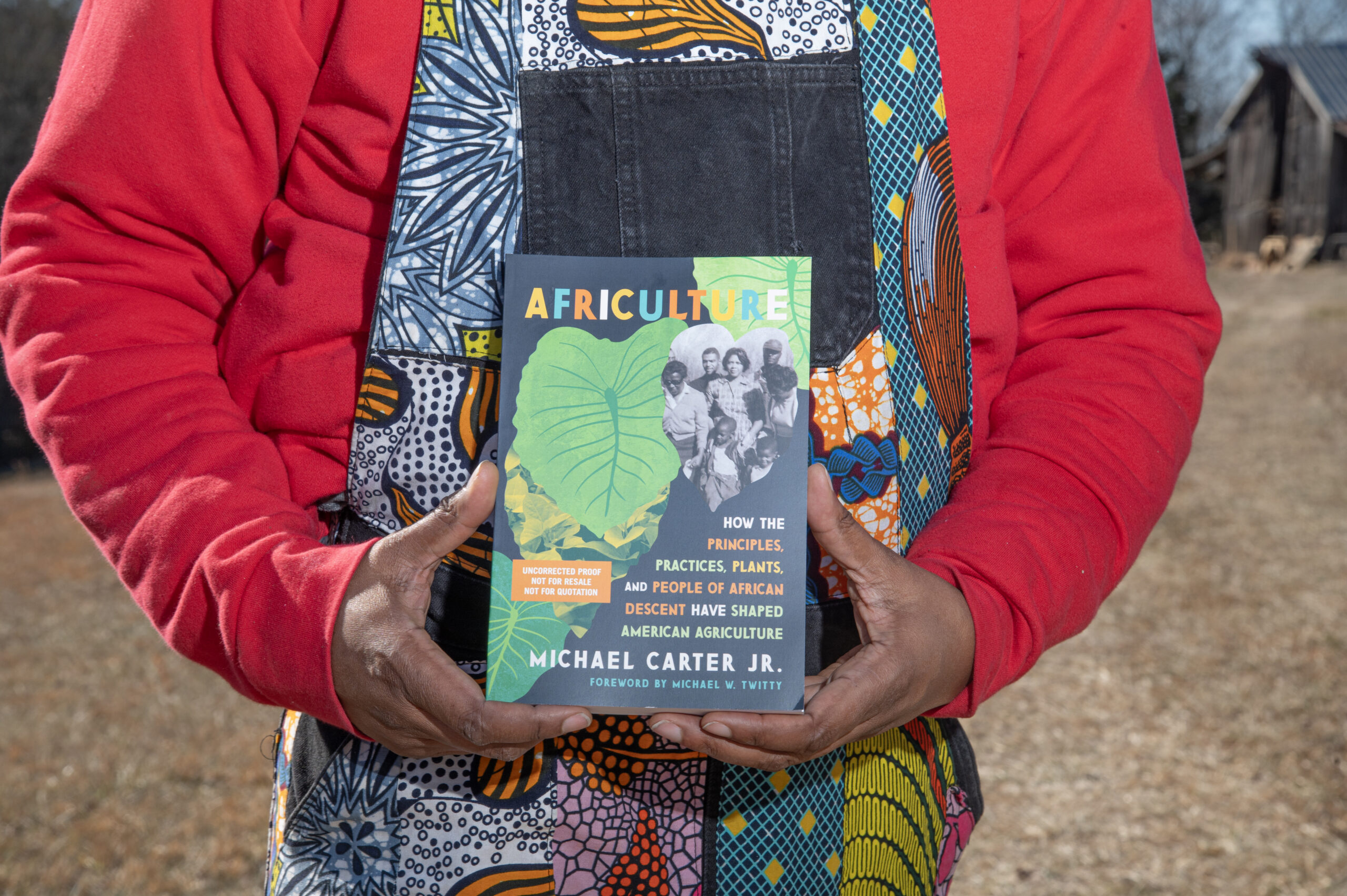
Carter’s book “Africulture: How the Principles, Practices, Plants, and People of African Descent Have Shaped American Agriculture” is set to publish on May 19.
Learn more about Carter Family Farms at thecarterfarms.com and about Carter’s nonprofit at learnafriculture.com.