When Abraham Lincoln and Frederick Douglass first met in August 1863, Douglass was no fan of the president.
Although Douglass had been recruiting Black soldiers for the Union army, he was angry and frustrated that they weren’t being treated the same as White soldiers. Douglass went to the White House — uninvited — and pressed Lincoln on the issue.
Lincoln told him that Black soldiers would eventually get equal pay but that political realities meant it would take some time. Douglass was disappointed that Lincoln wouldn’t act more quickly, but he also appreciated that Lincoln treated him as a gentleman. It was the beginning of a process by which Douglass came to have a much more positive view of Lincoln.
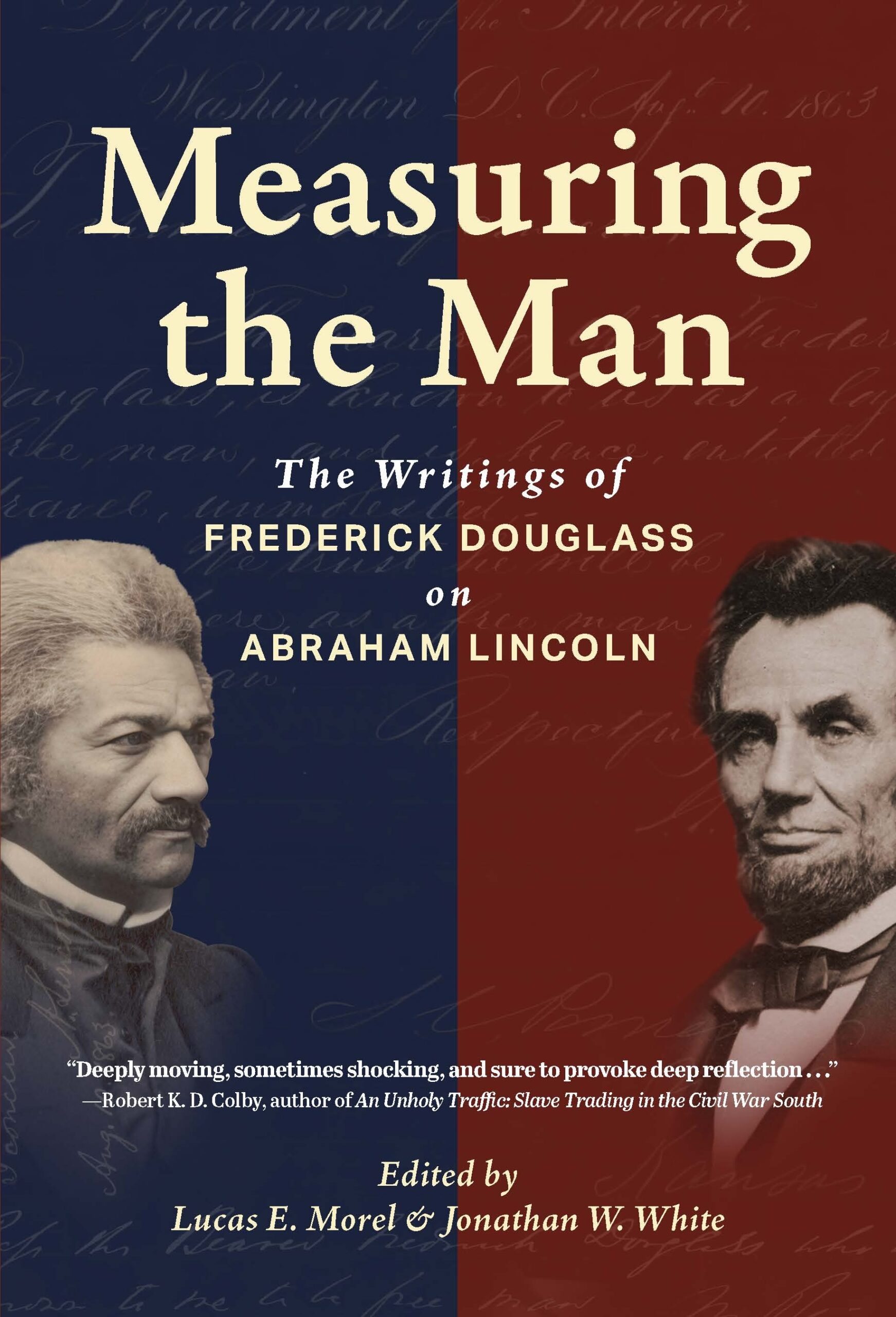
The relationship and correspondence between Lincoln and Douglass form the basis of Jonathan White and Lucas Morel’s new book, “Measuring the Man: The Writings of Frederick Douglass on Abraham Lincoln.” White will discuss the book on Dec. 18 at the Virginia Museum of History and Culture, a talk which will also be livestreamed on Facebook and YouTube.
Originally, White wanted to create a short book, something that pulled together the highlights of what Douglass wrote or said about Lincoln. His plan was to include just the most famous speeches, letters and editorials that Douglass wrote during and after the Civil War. “But in the process of doing the research, I discovered nine new letters, two speeches, and another document or two that had never been seen by historians,” he says. “So, we decided to expand the book and make it as comprehensive as possible.”
After pulling together every document they knew of, the duo went through other published collections of Douglass’s writings before going to online newspaper databases, where they found even more writings. “We don’t know exactly how Lincoln felt about him before the meeting, but we know that after their three meetings, they came to see each other as friends,” says White. “They had mutual respect and admiration.”
That hadn’t always been the case. Douglass was especially critical of Lincoln during the first two years of the war. He was upset that Lincoln said he would enforce the Fugitive Slave Act of 1850, which Douglass believed was unconstitutional, and he thought that Lincoln should free the slaves much more quickly than he did.
These disagreements were rooted in their fundamentally different interpretations of the U.S. Constitution. Douglass believed that the Constitution was an antislavery document and that, if interpreted correctly, could be used to end slavery. “But Lincoln believed that the Constitution was a compromise that made some concessions to slavery,” says White. “So, Douglass was frustrated that Lincoln, an antislavery president, didn’t use his power to end slavery more quickly.”
The book’s strength lies in the nine letters that Douglass sent to British abolitionists. “In them, he shared very candid opinions that he never would have shared with American audiences,” White says. “These discoveries will be one of the big reveals that I make in my talk.”
The evolution of Douglass’ opinion of Lincoln over time adds to what the public and historians now understand of a crucial era in American history. Ultimately, Douglass came to appreciate that Lincoln’s strategy for winning the war was the best one, and that his own wouldn’t have been successful.
Douglass, once one of Lincoln’s harshest critics, came to be one of his greatest admirers. The way White sees it, Douglass’ view of Lincoln should be re-adopted today. “Lincoln made plenty of mistakes and was by no means perfect,” he says. “But he was an extraordinary leader, and Douglass got to witness that firsthand. Douglass, too, was an extraordinary leader.”
White says that learning so much new about Douglass made the book a joy to write. For the reader, one of the most compelling aspects of “Measuring the Man: The Writings of Frederick Douglass on Abraham Lincoln,” is getting a sense of these two great American leaders grappling with the greatest crisis in American history in real time.
And then there’s the legacy of their mutual admiration society. White thinks that, in some ways, Lincoln and Douglass joined forces most meaningfully after Lincoln’s death, once Jim Crow and legalized segregation became increasingly the norm after the fall of Reconstruction.
“Douglass constantly pointed back to his personal relationship with Lincoln as a way of reminding white Americans that, if the greatest president in American history could treat Black people with dignity and respect, then so could they.”
The book talk with Jonathan White titled “Unlikely Collaborators: Abraham Lincoln, Frederick Douglass, and the Promise of America” will be held on Thursday, Dec. 18 at noon at the Virginia Museum of History and Culture, 428 N. Arthur Ashe Blvd. Tickets