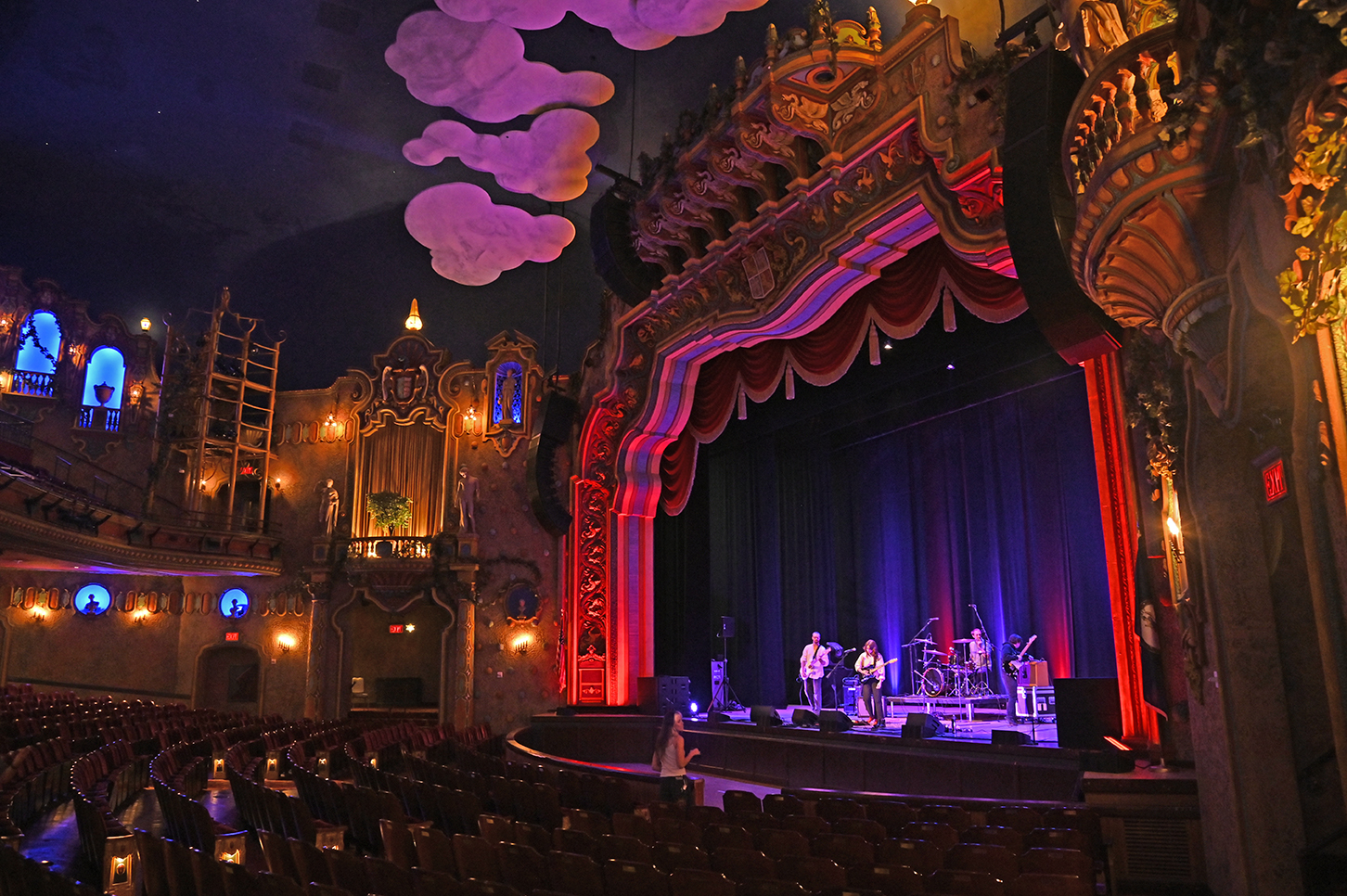
On Tuesday, Sept. 16, the Dominion Energy Center played host to a press-only event previewing upgrades to the venue’s entrance technology and front-of-house sound system. Many bands would leap at the opportunity to put a brand new, state-of-the-art speaker system through its paces. I leaped at the opportunity to be there, knowing that Richmond-based rock band Hotspit would be doing the honors.
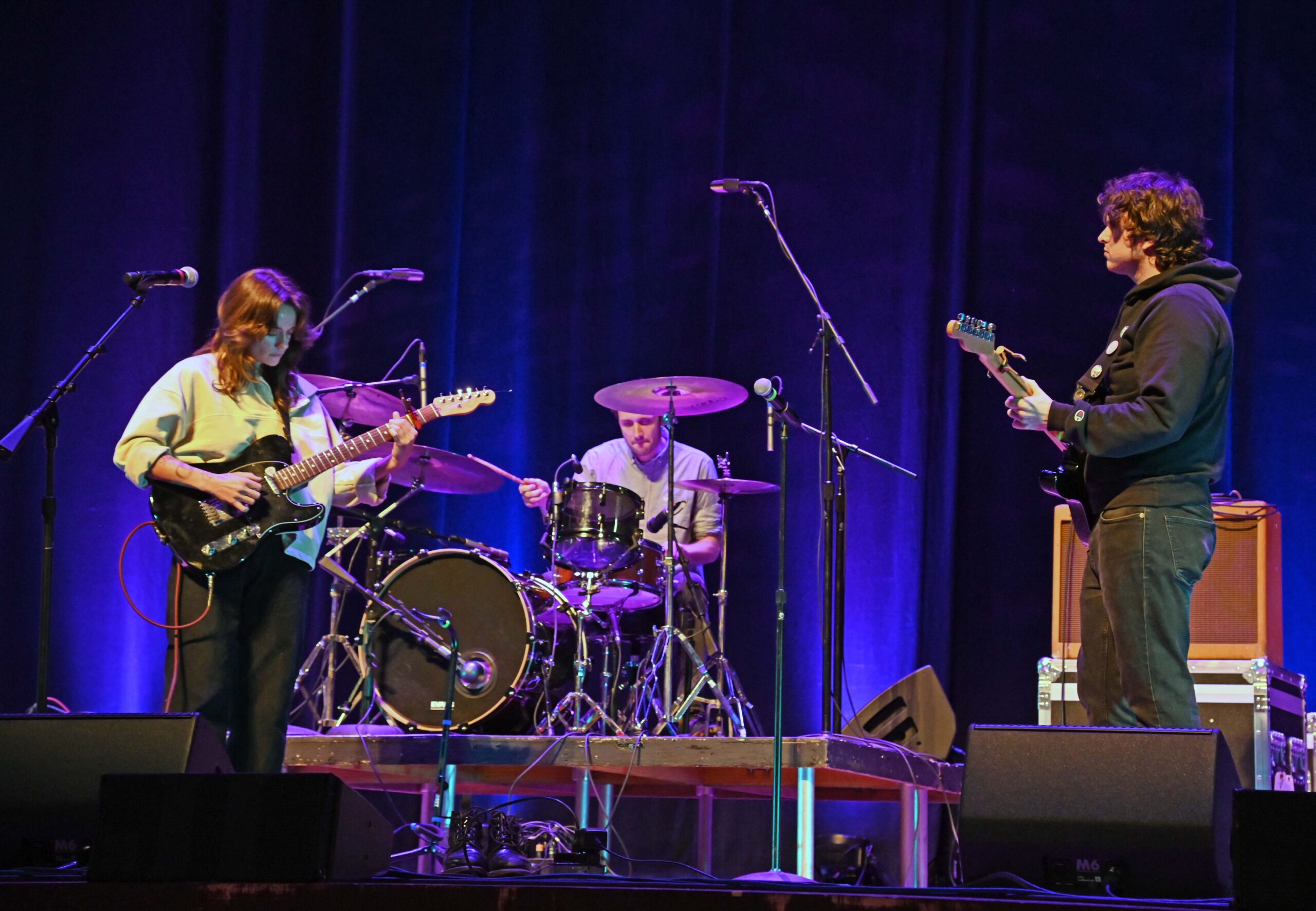
Surrounded by mediterranean architectural embellishments, with fiber optic stars twinkling overhead, journalists chatting in the lobby, and 1,800 empty seats instilling an eerie sense of calm, the quartet made a sound as vast as the Carpenter Theatre itself, running through selections from its soon-to-be-released debut full-length album, “(red wind).” The effect was uncanny, like slipping into a dream where you’re the last person on Earth, soaking in beauty not beholden to any witness.
As atypical as the performance was — hometown Hotspit shows tend not to want for attendees — it may have been the truest embodiment I’ve seen yet of the band’s mastery of sonic extremes. In Hotspit’s hands, quiet and its opposite work together to open up space listeners can fall into completely. No wonder they were called upon to demonstrate what a new set of speakers can do.
“(red wind),” which comes out on Friday, Nov. 14, was made in a setting that’s quickly becoming renowned for massive-sounding rock music: Asheville, North Carolina. The artistically bustling mountain enclave is home to Drop of Sun Studios, which aims to provide “a recording sanctuary for comfort, collaboration and creative inspiration,” according to its website. To hear the members of Hotspit describe it, the sanctuary aspect is spot on. “It is nice getting out there,” guitarist and founding member Kevin Ganley says. “You kind of leave everything in Richmond behind… It’s a great environment.”
“That studio is beautiful,” Grant Tolber adds. “Asheville is super peaceful.”
Perhaps there’s irony in the fact that the music coming out of Drop of Sun can get so loud. The studio’s list of clients includes critically acclaimed acts like Wednesday, Animal Collective and MJ Lenderman, as well as Angel Olsen, who stands among the present-day greats when it comes to cathartic rock that simmers before boiling over, and whom Fogarty has cited as influential when it came to finding their own songwriting voice.
Home away from home
Drop of Sun was co-founded by Alex Farrar, who happens to be an old friend of Ganley’s. The two bonded over punk, metal and Elliott Smith while attending middle and high school in Mechanicsville. Their paths diverged geographically before graduation, but Farrar and Ganley kept tabs on one another from afar, and Farrar suggested working together after taking notice of Hotspit’s 2021 live session for Audiotree. “The first thing was Avery’s voice,” Farrar says. “And the songs are catchy, but they’re a little nonstandard. It’s not really verse-chorus music but still really captivating and pulls you in like a verse-chorus song would… Also, just seeing Kevin rocking out, I was like, ‘Oh man, I love this.’”
“Yeah, let me run it by the band,” Ganley remembers saying to his former classmate. “We checked out some of the other records he had done, and they’re by some of our favorite artists. We were like, ‘OK, yes. We absolutely have to.’”
The partnership was quick to bear fruit. Two tracks that were principally recorded at Drop of Sun — “Wane Mouth” and “Cave Dweller” — were released as singles in 2022 before landing on Hotspit’s 2023 EP, “Memory of a Mirror Image.” “Cave Dweller” remains in rotation on WNRN to this day, and “Memory of a Mirror Image” went on to be shortlisted for the Newlin Music Prize the following year.
“It just seemed like a really good kind of chemistry from the jump,” Farrar confirms.
Trust is a hallmark of the band’s working relationship with Farrar, a quality Fogarty values given the intensity and vulnerability of the recording environment. “In that space, I find myself being really impressionable, so the person making the impression is really important,” Fogarty says. “I know it’s Alex, and I know the work he’s done.”
“He understands our strengths and weaknesses,” Ganley adds. “And the vision.”
To record “(red wind),” Hotspit took three trips to Asheville: the first in July 2023, the second that December and the last in March 2024. Those sessions happened to overlap with months in which Farrar and his wife welcomed their first child into the world. Farrar’s wife was nearly at term during the first session; by the second, the baby had been born and Farrar’s schedule had been truncated accordingly. By the third, Grant had gifted the new member of the Farrar family a stuffed otter. “That’s been beautiful, to get to know him through that lens,” Fogarty says. “The studio does feel really family oriented.”
With the time they had at Drop of Sun, the group looked to minimize overdubs, maximize tracking in the room together and heap on the heft in comparison to previous releases. “I think we wanted to be a little heavier this time around,” Ganley notes.
“Kudzu” is proof. The song starts out with heavily distorted guitar clocking unhurried quarter notes and only grows thicker from there, the tempo eventually slowing and the rhythm section syncing up so that each beat lands like a strike from one massive, lurching machine. “I think we’re evolving as songwriters together in that way,” Fogarty says. “A lot of us listen to heavier music, and I would like to have our taste emulate the material we’re making.”

A dynamic quartet
Hotspit got its start thanks in part to Avery Fogarty and Kevin Ganley’s shared tastes. Both grew up outside of Richmond: Fogarty in Midlothian, Ganley in Mechanicsville. After teaming up on the open mic circuit — playing acoustic guitars, covering Big Star, Leonard Cohen and Elliott Smith — the duo decided to move into the city and focus on making music together. That was around the start of 2018.
Fogarty and Ganley have largely traded acoustic guitars for electric ones in the years since, forming a powerful partnership. At any given moment during a Hotspit song, there are typically multiple ear-catching guitar parts unfolding, often combinations of intriguingly knotty chords and carefully chosen countermelodies. The two founding members exchange roles fluidly, lending great depth to Hotspit’s sometimes-dark, often crunchy soundscapes.
“It’s kind of split,” Ganley says about his and Fogarty’s roles as guitarists. “With some songs, I will come up with something right away, and then other songs, Avery will have a particular melody in mind… Grant or Kurt will also be like, ‘What if we played this here?’ I’m always open to suggestion.”
Bassist Grant Tolber’s background is actually in guitar, though he entered the Hotspit orbit by filling in a few times for the group’s previous bass player — initially testing the waters by playing root notes and eventually settling into the role on a permanent basis. Drummer Kurt Bailey joined up after gaining experience playing in the Philadelphia-via-Richmond indie-folk group Addy. With a deep pool of talent to draw from, the group enjoys a collaborative approach to writing in which there’s plenty of room to contribute, and plenty of momentum.
“We play as a four-piece, we write as a four-piece, and these are how the songs sound to us,” Fogarty notes. “We don’t really, unfortunately, do that many demos before we go to studio.”
The new album’s second single, “Silvered,” flows like a microcosm of that drive to keep moving — lines stepping up and down the scale to form tonal topography that’s a pleasure to click into. It’s as melodic and groove-based as anything you’ll hear in Hotspit’s repertoire. For Kurt Bailey, it was easy hitting that stride in the studio. “Honestly, I hardly really remember recording because I just remember it coming really naturally,” he says.
Stepping forward in the mix
Fogarty’s home recordings have dealt with pace and melody differently. Some singles skew ambient, while others veer toward collage. Found sounds drift in and out, mingling with folk instrumentation. Voices appear, overlap and recede, and liner notes frequently leave cryptic breadcrumbs. Fogarty can be heard most between and around the layers — a quality the singer regularly weaves into Hotspit’s live performances, thanks to their preternatural gift for vocal dynamics.
Yet in “(red wind),” Alex Farrar hears the strides Fogarty has been taking toward the front of the mix. “I’ve seen them more solidly step into that role to direct the vision of the band with more confidence,” Farrar says of Fogarty. “Kurt, Grant and Kevin — their inclinations will always be a very distinct part of why they sound the way they do. But Avery being a sort of creative director of the band like that — I’ve seen that solidify more in the in the past few years.”
“Bent Trees” is its own leap forward — a lyrical statement that packs an emotional wallop with its directness: “I’ll love you forever but needing a family shouldn’t be this hard / And you know who you are.” The song got an instrumental boost from the addition of piano by Asheville’s own Jack Victor of the band Slow Packer at Alex Farrar’s suggestion.
Fogarty was surprised by the song’s evolution: “I didn’t expect it to be a strong song when we were bringing it. I felt passionate about it, [but] I wrote it fast… Then when the piano was in and we were listening back, I was like, ‘Wow, this sounds like so much better than I remember it being…’ I didn’t think it would ever be my favorite. It’s not as hooky. It’s not as in your face. But listening to everything we have, it’s one of my favorites.”
Road testing “(red wind)”
Since that unique performance at the Carpenter Theatre, Hotspit has given audiences up and down the East Coast — and as far south as Birmingham, Alabama — the opportunity to choose their own new favorites. The band recently completed a pair of week-long tour legs, one in support of Goon, the other with Asher White.
“I love being on the road,” Kevin Ganley says with a smile. In fact, he’d happily head out for longer stretches. “Every time we tour, for the first five, six, seven days, I’m still in home mode and missing my bed and being at home, then we get into the groove. Usually our tours are only 10 or 11 days, so by the time I get really into it, it’s over. So in the future, I’d like to go on some longer ones where it can feel fully immersed.”
A recent road highlight came when the band played Baby’s All Right, the famed Brooklyn club. “There was a good turnout,” Grant Tolber notes. “I think a lot of our friends that live up there came out.”
Then again, Hotspit isn’t keen on looking back. Their drive to create is too brisk. “We started writing past the record,” Kurt Bailey notes.
“We’re writing because it is what we do,” Fogarty says. “We’ll have more of a complete project by the time this comes out, hopefully to bring to a studio and not rush, per se, but feel more comfortable with the material for the next round.”
Fogarty confirms there were a couple of rounds of pitching “(red wind)” to labels, but the group’s preference for progress took hold before a partnership materialized. “It gives us a lot of agency,” Fogarty says of self-releasing the album. “We sat on it for long enough that we were like… ‘We’re about to go on tour, so maybe we should start dropping singles.’ We’re kind of sloppy [but] I wouldn’t have it any other way.”
Fogarty has spoken with Style Weekly in the past about how releasing songs is akin to turning the page on the chapter of life that inspired them. “(red wind)” is no exception. “It feels good to move past, because I feel really proud of these songs,” Fogarty says.
“(red wind)” is out on Friday, Nov. 14. To hear and purchase the album, visit hotspit.bandcamp.com. For information on Hotspit’s upcoming performances, visit hotspitband.com.